
As Sea Level Rises, Owners and Buyers Need to Read and Understand Condo Documents, Condo Board Meeting Minutes, and Financials

As sea level continues to rise, condo buildings along the coast are confronting greater challenges. The cost of insurance is ever-increasing as is the cost of maintaining buildings that are coming into greater contact with corrosive sea water.

As a result, the days of coastal condo owners being able to buy a condo and ignore how the building its located in is being managed are over. One powerful lesson from the tragic condo collapse in Surfside, Florida, last summer — which some engineers suspect may have been in part brought about because condo owners didn’t buy in on required maintenance — is that owners can’t afford to stay out of the management loop.

Buyers, too, need to invest some time in studying how well a condo building is being managed. They need to know if owners are committed to building up the reserves necessary to pay for routine maintenance, covering the cost of unanticipated repairs, and taking the steps necessary to adapt the building and common area to prevent sea level rise flooding. They also need to know how quickly insurance costs are increasing and if there are any repairs under consideration that may lead to costly special assessments.

Condo financial statements, condo documents, the minutes from condo board meetings, and copies of correspondence between the condo board and owners are a great way to find out how committed a condo board and owners are to maintaining a building and its common area.

Owners should have easy access to all documents. Buyers, on the other hand, need to know the rights they have in the state the building is located in to acquire copies of the financials and documents, how long they have to review them, and whether or not they can withdraw an offer based on what they discover during the review period.

In states where buyers have no legal rights to review the financials and documents, they may want to request them in writing with a defined time limit for review from the seller before they submit an offer or submit an offer with a written contingency that they can withdraw the offer if they don’t like what they see.

Buyers should consult a real estate attorney regarding how to initiate this review process. They might also want the attorney to review the condo financials and documents to identify any red flags.

The seas aren’t going to stop rising any time soon. To protect their financial futures, owners and buyers need to set aside time to find out what’s really going on in a building of interest located along the coast.
Powerful New Tool Gives Real Estate Owners, Developers, Planners & Government Officials a Detailed View of the Threats Posed by Sea Level Rise

One of the greatest challenges for coastal real estate owners, developers, planners and government officials is acquiring a detailed understanding of the complicated challenges sea level rise flooding poses to their communities.

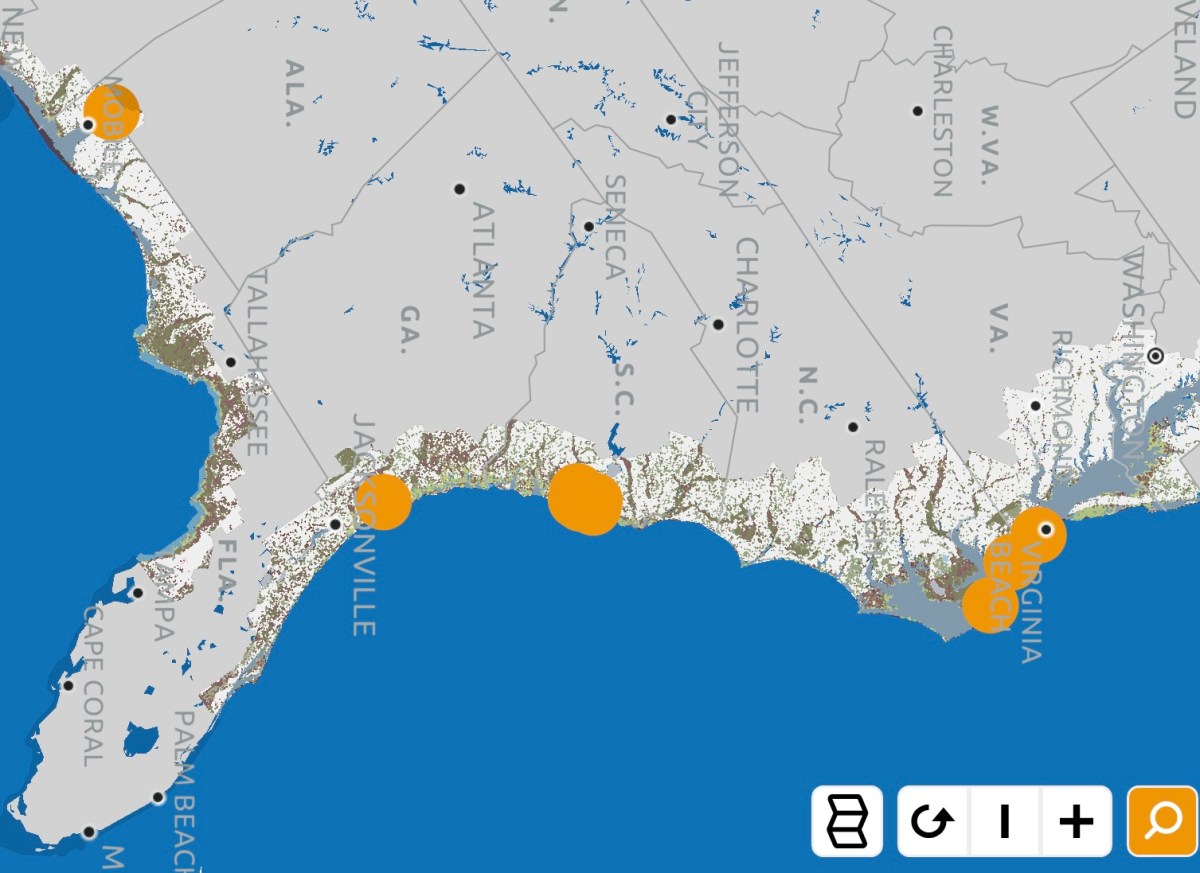
A new tool introduced today by the Southern Environmental Law Center (SELC), a non-profit and non-partisan organization dedicated to defending the environment, aims to deliver a clear view of the threats sea level rise poses to coastal communities in the Southeast through the use of an interactive mapping tool. “The project’s goal is to show citizens and decision-makers how the coast is changing,” the SELC said in a news release, “and how proposed infrastructure projects like highways, neighborhoods, and government or industrial facilities will fare as the water keeps rising and floods get worse.”

Visitors to The Changing Coast website will find an interactive map with overlays that enable them to visualize: 1. The flooding that will occur in their community as sea level rises; 2. Development projects that will be impacted by higher seas; 3. The locations of toxic Superfund sites that could contaminate neighborhoods and water supplies if they’re flooded by ocean water; 4. The locations of socially vulnerable populations who are most at-risk from sea level rise flooding and storm surges; 5. Wetland areas and floodplains that need to be protected from development to act as sea level rise floodwater buffer zones; and 6. Areas that are most at-risk from more powerful storm surges resulting global-warming-fueled stronger hurricanes and tropical storms.

Among the real-world examples of areas where the interactive mapping tool could assist real estate owners, government officials, planners and developers in coastal communities, the SELC offered the following:

  • “A proposed 9,000-acre housing development in Charleston could flood now with just a Category 1 hurricane. And rising seas could put parts of the development under water before the mortgages are paid off.”
  • “The roads leading to the proposed Mid-Currituck Bridge in North Carolina could be flooded on sunny days in the future if sea level climbs just two feet, rendering the span useless.”
  • “A 21-million-ton pile of toxic coal ash on the banks of the Mobile River in Alabama could likewise be threatened by a Category 2 hurricane, and that threat only increases as sea levels continue to rise. A breach could spread toxic ash into the river, through the Tensaw Delta, and into Mobile Bay.”

“The goal is to help guide decisions for the future, and to plan smart strategies to protect what exists now,” said Chris DeScherer, and SELC senior attorney.

The SELC’s interactive map is a valuable source of information that real estate owners, buyers and agents in the Southeast should use when considering property in coastal communities currently experiencing sea level rise flooding or at-risk of experiencing it in the near future. It would be wonderful if this powerful tool became available in other parts of the country.

Want to Fend Off Sea Level Rise Flooding? Start with Your Natural Gas Stove

A study released last week that concluded natural gas cooking stoves in the U.S. alone are leaking the equivalent of 500,000 cars-worth of greenhouse gases every year is a powerful reminder that real estate owners must play a role in combatting global warming and sea level rise flooding.

Researchers at Stanford University said in the study, published in the journal Environmental Science & Technology, that natural gas cooking stoves in over “40 million U.S. residences release methane — a potent greenhouse gas — through post-meter leaks and incomplete combustion.” They noted that three-quarters of the methane was released when the stoves were off. Around 80 percent of the methane leaked from loose couplings and fittings that connect gas pipes to stoves.

For years, the natural gas industry worked to convince the public that natural gas was a clean energy alternative. Using natural gas to produce energy does in fact release half as much carbon dioxide as burning coal to generate the same amount of energy. But scientists are increasingly concerned that the production and transportation of natural gas is leading to the release of dangerous amounts of methane — a more potent but shorter lived greenhouse gas than carbon dioxide — into the atmosphere.

A report published by Global Energy Monitor, a non-profit that monitors the fossil fuel industry, concluded that projects the oil and gas industry plan to fund to increase the use of natural gas globally would lead to the release of greenhouse gases in excess of all the coal fired plant put together. Ultimately, natural gas could keep us on track toward climate change catastrophe.

So what’s a homeowner to do? Climate groups are encouraging them to replace their natural gas powered stoves, hot water heaters and other appliances with electric appliances. For those who can’t afford to replace them, Rob Jackson, a professor of earth sciences at Stanford who was one of the stove study authors, told National Public Radio said they should use a wrench to tighten the connectors between pipes and stoves. The American Gas Association told NPR this work should only be performed by licensed professionals.

The point of this story is that people who own real estate in coastal communities that’s threatened by sea level rise flooding should certainly do everything they can to, such as raising seawalls and structures, to protect their property from rising waters, which is a symptom of climate change and global warming. But they also need to do everything they can to reduce the root cause of the problem, which is clearly any human activity that leads to the burning of fossil fuels and the release of greenhouse gases into the atmosphere.

If they have a gas stove, they need to replace it or make sure it’s properly maintained. Other steps they can take to help include ensuring that their property is weather-proofed and equipped with the most efficient appliances available today. Even switching off lights and electronics that aren’t being used can make a difference.

Miami-Dade County Begins to Address Thousands of Septic Tanks Failing Due to Sea Level Rise

Sea level rise has many negative consequences on coastal communities. One of them is causing septic systems to fail.

How dow this happen? As sea level rises, saltwater migrates inland underground through porous rock, such as limestone. As it moves, the denser saltwater forces the freshwater water table to rise toward the surface. If the water rises high enough, it can saturate soils near the surface.

Septic systems take wastewater from a home and sends it to a concrete box buried underground. From there, the effluent is distributed underground through soils that remove impurities. If the soil is already saturated, however, it can’t absorb the wastewater and remove the impurities. As a result, the untreated wastewater can emerge and pollute the land and streams, rivers, estuaries, bays and other bodies of water.

Miami-Dade County in South Florida has thousands of septic systems that are failing due to rising seas. The problem is so bad experts say some of the the septic systems are sending untreated wastewater into Biscayne Bay, where it’s killing fish and other marine animals.

To fix the problem, county officials broke ground on a project to disconnect thousands of homes from their currently failing or at-risk septic systems and hook them into the municipal wastewater treatment system. The county has $230 million to invest in converting 13,000 of the counties 120,000 septic systems over the next five years. Their immediate goal is to address the 9,000 tanks that they believe are polluting Biscayne Bay.

Miami-Dade has funding to bring sewer lines up to property lines, then it’s up to property owners to cover the cost of new pipes to hook into the municipal wastewater system and to remove the failing septic tank. Estimates are real estate owners will have to spend $10,000 out-of-pocket to do this. The county has state funds available to help low-income residents with the expense.

Oddly enough, the county is still issuing permits for the installation of new septic tanks. County officials told the Miami Herald that it continues to issue permits because some Miami-Dade residents can’t afford to tie into the municipal wastewater system and because developers are building homes in places where municipal sewer lines haven’t been installed.

Aaron Stauber, an environmentalist and board member of Miami Waterkeeper, applauds the county for starting to address the septic system issue. He told the Miami Herald, however, that the county should only allow development in areas that already have sewer service or force the developers to install new sewer lines.

Coastal real estate owners who have properties served by septic systems clearly need to keep abreast of any changes to regulations that govern their septic tanks. Buyers in those areas need to know whether a property of interest is served by municipal wastewater systems or septic tanks. They also need to know if the septic tank is in good working order and if the local government has any intention of forcing homeowners to tie into the municipal system.

When It Comes to Sea Level Rise and Real Estate, What You Can and Can’t See Can Hurt You

If you’ve lived in condo buildings near the coast for twenty years as I have, you know that every so often the buildings have to be inspected as part of routine maintenance. When inspectors find areas of stucco, concrete and rebar that have deteriorated due to intrusion from salty ocean moisture and rain, crews have to remove the trouble areas or, in some instances, reseal entire buildings. This type of pro-active maintenance is the sign of a well-managed building.

After the tragic collapse of Champlain Towers South in Surfside, Florida, last summer, that resulted in the deaths of 98 people, some structural engineers wondered if sea level rise had caused ocean water to bathe underground support structures and garage walls, contributing to the building’s collapse. No ruling has been made to date, but the building’s collapse has caused some coastal cities and towns to either implement stricter building inspection protocols or to wait and see if the state is going to pass tougher inspection rules.

Regardless of their state’s inspection rules — which vary widely — owners and buyers of coastal real estate need to take the initiative and consider the risk rising seas pose to coastal real estate. Owners can no longer passively rely on their condo boards to do what’s right for their buildings. They need to get involved and make sure that they’re up to date on inspections, their buildings are being well-maintained, repairs are made promptly when problems are found above and below ground, and reserves are being built for the day when repairs are needed.

Buyers, too, need to make sure that their pre-purchase inspections include not only an analysis of their unit, but a detailed look at the current condition of the buildings and common areas — including beaches, seawalls, steps and garages. They also need to know how well the buildings have been maintained, the commitment of the condo boards to conduct routine maintenance and build reserves to cover them, and whether or not there are repair projects that need to be implemented in the near future — especially since they can lead to hefty special assessments.

In addition to gathering this information, owners and buyers should have a sense of how ever-rising seas are expected to impact their buildings and neighborhoods during the period they hope to live in the property. Sea level rise flooding can make roads unusable and interrupt essential services. It can also lead to increased carrying costs, including condo fees, special assessments, taxes, and insurance.

Sea level rise poses risks above ground and below ground in vulnerable coastal communities. Everyone involved in coastal real estate needs to acknowledge that it’s a growing problem and do what they can to protect their lives, properties and financial futures.

Sea Level Rise Increases Conflict Over Public Access to Private Beaches

When buyers purchase real estate on the beach, they often assume they own the entire stretch of sand from their door to the water’s edge, but that’s not always the case. Property owners in states like California and Florida own the beach up to the point where water laps at their beach at high tide. The public is allowed to walk in the wet sand that emerges between mean high and low tide. States like New Jersey, North Carolina, Oregon and Texas, on the other hand, allow public access to all beaches.

State laws, however, aren’t always the last word when it comes to beach access. Federal law requires coastal communities to provide public access to beaches that have been restored using federal funds. Public access doesn’t end until a beach is eroded away again. (This article by Thomas Ankerson, director of the Conservation Clinic at the University of Florida College of Law, does a great job of explaining the legal issues surrounding beach access.)

As sea level rise causes more beach erosion, property owners are finding beach walkers ever closer to their back doors. In some communities, this is increasing tension that already existed between property owners who believe they have a right to the quiet enjoyment of their stretch of beach and the public who believe no one should have exclusive right to the sand.

In Florida, the state with the most beaches, battles are breaking out between some beachfront property owners and the public. A recent example is a conflict emerging in Palm Beach in South Florida. According to an article published this week by WPTV, a West Palm Beach TV station, private property owners in the tony resort community are posting poles that tell beachgoers where their private beach starts and warning them not to trespass.

Christine Stapleton, a form Palm Beach Post reporter and beach walker, posted a photo of a pole on Instagram. “Legally, these landowners do own the beach up to the mean high tide line,” she wrote in her post. “And Article X, Section 11 of the Florida Constitution clarifies that the state holds the seaward of the mean high-tide line (MHTL) in trust for the public.”

Stapleton then goes on to question the authorities’ role in allowing private property owners to unilaterally claim a section of the beach that should be open to the public. “So why does the Town of Palm Beach and Florida Department of Environmental Protection allow wealthy landowners to decide the location of the mean high tide line?” she asks. “Why does the town and DEP allow these landowners to decide when a public beach should be closed because of erosion and put up poles declaring the eroded stretch of beach private and claiming ownership?”

Palm Beach’s town manager told WPTV that the property owners need to follow state guidelines when they post poles.

As sea level rise continues, conflict between private property owners and beachgoers is bound to increase. It’s important for real estate buyers and owners to know their rights so they don’t overstep their boundaries and for the public to know where they’re allowed to tread so they don’t trespass. As Christine Stapleton told WPTV, “My feeling is let’s get together and make this work.”

Public vs. Private Interests Come to a Head Over South Carolina Seawall

Solving sea level rise flooding challenges requires public/private partnerships. For example, when a coastal community is defending itself against repeated flooding events, government officials may have to require that both public and private seawalls be raised to a certain height to create a continuous barrier to stop the floodwaters.

Sometimes, however, public and private interests are at odds and difficult decisions have to be made. Such is the case at Debordieu Beach in South Carolina.

According to an article in The State newspaper, the owners of four homes built a sandbag seawall to protect their property from severe beach erosion at a point where a wooden seawall is failing. In keeping with state law, staff members at the South Carolina Department of Health and Environmental Control (DHEC) ordered the seawall removed.

The property owners responded to the order by exploiting a loophole in the law. They found a scientist at Coastal Carolina University who agreed to study how well the sandbags performed as a seawall after they were buried during a beach nourishment project. Such experiments can be approved by the DHEC if there’s a chance they will succeed.

The staff members remained steadfast in their opposition to the seawall, saying that the science is established. Past experience has shown the seawall will make erosion of the public beach even worse. South Carolina has banned hard seawalls for this reason for many years.

On a 3-to-2 vote the DHEC’s politically appointed board voted to overrule the staff and allow the sandbag seawall to remain.

Observers are concerned that the board’s decision will lead to more property owners installing sandbag seawalls or other experimental methods to protect their real estate with the potential loss of sandy beaches.

This type of public/private conflict is occurring in other areas, too. For example, property owners in Charleston, SC, and Miami, FL, are concerned that high barriers proposed to stop storm surge will block their views. And homeowners in Miami Beach, FL, have sued the city after roads elevated to stop sea level rise flooding have actually led to their property being flooded by rainstorm runoff.

As sea level continues to rise, there’s bound to be more conflict between public/private interests. In cases where what’s good for the public isn’t necessarily good for a private real estate owner, following the science for the greater good is the best policy. Seeking solutions that help property owners to adapt to any changes made that impact their property or fairly compensating them when sacrifice is the only solution has to be part of the mix, too.

Another Florida City Passes a Seawall Height Ordinance to Fend Off Sea Level Rise Flooding

As sea level continues to rise and flood real estate, coastal communities are starting to wake up to the fact that a laissez-faire approach to seawalls won’t cut it any more. If the height and maintenance of seawalls isn’t regulated by cities and towns, there’s a chance floodwater is going to course over the lowest seawall in a series and flood the owner’s and neighbors’ properties, not to mention critical roads and infrastructure.

This week, the city commission in Delray Beach — located in southern Palm Beach County, Florida — responded to sea level rise flooding from inadequate seawalls along the Intracoastal Waterway. By a unanimous vote, the commission approved seawall ordinances similar to a breakthrough seawall ordinance passed two years ago in Broward County, Florida, that covered Fort Lauderdale and other coastal cities and towns.

Delray Beach’s new regulations close a gap that allowed private property owners free range over their seawalls, even if they were deficient and causing flooding problems for the surrounding area.

“The city is where the rubber meets the road,” Vice-Mayor Shirley Johnson said. “The county isn’t going to say this is going on. The state isn’t going to do it. And the federal government? They’re so far away they don’t even halfway know what’s going on, even though the Army Corps of Engineers does their level best. … So the city is left to do the work of enforcing, monitoring, being aware.”

The seawall regulations require the owners of new construction properties to build seawalls 4.2 feet over the base flood elevation as identified in FEMA Flood Insurance Rate maps. If the owner builds a seawall under that height, it must be designed to allow the construction of a height extender to bring it in line with the regulation.

City officials said they don’t plan to aggressively enforce the seawall regulations. According to the regulations, however, if flooding is reported from a deficient seawall, the city will require the owner to “demonstrate progress toward repairing the cited defect within 60 days of receiving notice from the city, and complete any necessary repairs within 365 days of receiving notice.” Property owners could face fines if they fail to meet the requirements.

In addition to the seawall height and maintenance requirements, the new regulations require sellers to disclose to buyers that the property of interest is subject to the new ordinances. The following language must be included in sales contracts: “This real estate is located in a tidally influenced area. The owner may be required by county or municipal ordinance to meet minimum tidal flood barrier elevation standards during construction or substantial repair or substantial rehabilitation to the property or the seawalls, banks, berms, and similar infrastructure or when required to abate nuisance flooding.”

With sea level rise continuing and, quite frankly, accelerating, more coastal cities and towns are bound to consider similar seawall regulations. Real estate sellers and owners and real estate agents in coastal areas need to stay aware of what’s happening in their communities as the regulations can have costly consequences.

The cost of building or repairing a seawall can run well into the tens of thousands of dollars or even higher, depending on the length of the seawall and the materials used. In addition, acquiring permits for seawall construction from federal, state, county and local governments can require a fair amount of paperwork and take longer than 365 day project completion limit.

Record High Ocean Temperature has Serious Consequences for Coastal Real Estate

For the third year in a row, global ocean temperature was the hottest on record in 2021, according to a study published today in the Journal Advances in Atmospheric Sciences. Furthermore, the past five years have seen the hottest ocean temperature in over 60 years.

The increase in ocean temperature is tracking ever higher temperatures recorded on land and in the atmosphere. Scientists blame humans burning fossil fuels — such as coal, oil and natural gas — for the global warming that started during the Industrial Revolution.

As ocean water heats up, it expands. Experts credit 1/3 of sea level rise to expansion. The rest is due to glacier melt running off into the sea.

In addition to sea level rise flooding, warmer ocean water threatens coastal real estate by increasing glacier melt and by fueling stronger tropical storms and hurricanes and more intense rainfall events. It also threatens to contaminate fresh water supplies through saltwater intrusion.

Kevin Trenberth, a study author and scientist at the National Center for Atmospheric research in Colorado, told CNN: “To stop this (trend), we really need to get to net-zero (emissions), and many countries have plans but not enough actions to support those. In the meantime, we must prepare better and build resilience.”

“Changes to engineering design, building codes, and modifications to coastal development plans are recommended in anticipation of increased sea levels and increases in extreme precipitation events, which are already being observed,” according to the study.

Sea Level Rise Flooding is Forcing Coastal Communities to Pass Seawall Height Mandates for Real Estate Owners

We’ve all heard the saying “A chain is only as strong as its weakest link.” The same is true for seawalls. A coastal community can strive to build a solid line of seawalls high enough to prevent ever-worsening sea level rise flooding, but if one public or private seawall in the series isn’t high enough to deal with the the next extreme tide event, floodwaters can inundate nearby real estate.

This reality is forcing communities to consider seawall height requirement ordinances similar to a law passed a few years ago in Broward County, Florida. According to the county’s “Build It High, Keep It Dry” brochure: “All property owners must maintain a tidal flood barrier in good repair. A tidal flood barrier is presumed in disrepair if it allows tidal waters to flow unimpeded through or over the barrier and on to adjacent property or rights-of-way. If a property is reported and documented to cause flooding of adjacent roads for neighboring properties it will be cited and required to prevent flood trespass within one year.”

The county says the seawall ordinance, the first in Florida, benefits property owners because it encourages them to budget for seawall adaptations before flooding occurs, which also protects their property value. A list of action steps recommended by the county includes determining the property elevation, gathering construction quotes, considering financing options, hiring an experienced contractor (who will get the required permits from the city, county, state and U.S. Army Corps of Engineers), and actually constructing the new seawall or flood barrier.

The impact of the new seawall ordinance on real estate owners is substantial. For example, a property owner can be fined for failing to maintain seawalls that prevent flooding. They are also required to disclose to buyers that seawalls are covered by the new law. A contract for sale in an affected area must state the following: “This real estate is located in a tidally influenced area. The owner may be required by county or municipal ordinance to meet minimum tidal flood barrier elevation standards during construction or substantial repair or substantial rehabilitation of seawalls, banks, berms, and similar infrastructure when required to abate nuisance flooding.”

Buyers, sellers, owners and real estate agents need to pay attention to the passage and implementation of seawall height requirement laws in their communities. The cost to repair or replace a seawall can run into tens of thousands of dollars — or even more — depending on factors such as the length of the seawall, its design, and the construction materials used. Real estate agents should encourage buyers to have seawalls inspected before submitting an offer. They should also make sure that sellers include any required language regarding local seawall ordinances in sales contracts.

Owners, too, should consider getting their seawalls inspected to make sure they meet the local codes. Inspection results will also help them to budget for any current or future repairs that may be needed. Seawalls typically last 30-50 years before they need to be replaced, but sea level rise, which is accelerating as the climate warms, may shorten their lifespan.

As with all laws that attempt to address global warming and sea level rise flooding, the new seawall height ordinances are bound to result in property owner lawsuits. The truth is, however, that lawsuits are not going to stop sea level rise — reducing the release of greenhouse gases will — and, ultimately, someone is going to have to pay the freight to upgrade seawalls to prevent flooding to extend the time that coastal communities will be inhabitable. Buyers and owners need to assess the cost to make informed real estate decisions.