Latest UN Climate Change Report is Bad News For Real Estate Threatened by Sea Level Rise and the World in General

The Unite Nation’s climate science panel released a report this week that was bad news for real estate subject to sea level rise, wildfires, drought and other environmental threats tied to global warming.

Researchers found that humans continue to burn more and more fossil fuels, which releases ever-increasing amounts of greenhouse gases, at a time when we need to drastically reduce output. At the current rate of emissions, we’re set to blow through the 1.5 degrees Celsius temperature increase limit past reports set for this century. We’re headed for 3.2 degrees Celsius. At this point, even if nations realize their past greenhouse gas emissions reduction targets, the world would still see 2.2 degrees or more of warming.

The National Oceanic and Atmospheric Administration recently released a report that estimated US coastal cities and towns would see an average of a foot of sea level rise between now and 2050. That estimate was based on 1.5 degrees Celsius of warming. If the globe warms much faster than that, the ocean will expand much faster and glaciers and ice sheets primarily in Greenland and Antarctica will melt faster contributing to faster and greater than predicted sea level rise.

U.S. coastal communities and private real estate owners are already spending billions of dollars to fend off sea level rise-driven floodwaters. They’re building and raising seawalls, installing pumps to remove floodwater, elevating land, homes, and government and commercial buildings, and hardening and/or elevating infrastructure, such as roads, sewer and water pipes and underground energy and communications equipment. If humans don’t drastically reduce their reliance on fossil fuels — such as coal, oil and natural gas — these projects won’t be enough. Last-resort measures such as managed retreat — property buyouts in flooded areas — will increasingly become the norm.

Faster and higher sea level rise will not only lead to more frequent tidal flooding of vulnerable coastal areas, it will also result in more powerful storm surges being driven further inland. All together, this will apply incredible pressure on the already strained insurance and mortgage markets in coastal communities.

UN report researchers say we need to cut all greenhouse gas emissions in half by the next decade. The best way to do this is by relying more heavily on renewable energy sources, such as solar and wind power. Improving energy efficiency in homes and businesses and energy conservation practices also play an important role.

Fortunately, these goals are within reach. For example, the cost per unit of solar energy is 85% less than it was in 2010. The cost per unit of wind power is 55% cheaper.

The X factor in all of this is our political will and personal commitment to changing our habits to achieve these objectives. The world’s nations have been less-than-honest about the efforts and results they’ve achieved so far in the fight against climate change, global warming, and sea level rise. Not being forthright with the facts is dangerous for us all. The simple fact is when we gaslight Earth, we’re the ones who get burned. The planet’s chemistry and physics are well-established, and the its rules can’t be broken without resulting in a world that is inhospitable to human life.

UN scientists say we have a very narrow and quickly closing window of opportunity to fend off the worst case global warming scenario. Each and every one of us has a role in preventing that outcome.

New CO2 Emissions Record is Bad News for Sea Level Rise and Real Estate

A few weeks ago, the National Oceanic and Atmospheric Administration (NOAA) released a startling report that predicted the US coastline would see on average a foot and up to 18 inches of sea level rise by 2050. The agency said the next 50 years of potential sea level rise after that will be heavily influenced by the amount of fossil fuels — coal, oil, and natural gas — that’s burned, releasing carbon dioxide (CO2) into the atmosphere and causing it to continue warming up. This week, the long-term sea level rise outlook took a turn for the worse when a report was released that said the world reached a record for CO2 emissions in 2021.

The International Energy Agency (IEA), an autonomous intergovernmental organization that helps countries shape energy policies, analyzed public and private energy and economic data to reach the conclusion that “global energy-related carbon dioxide emissions rose by 6% in 2021 to 36.3 billion tonnes, their highest ever level”. The IEA blamed the increase in CO2 emissions on the global economic recovery from the Covid-19 crisis and an increased reliance on coal when the price of natural gas spiked.

The IEA said in a press release that the “world must now ensure that the global rebound in emissions in 2021 was a one-off and that an accelerated energy transition contributes to global energy security”.

The recent NOAA report explained why reducing, not increasing, emissions is critically important to coastal communities. The report said: “About 2 feet (0.6 meters) of sea level rise along the U.S. coastline is increasingly likely between 2020 and 2100 because of emissions to date. Failing to curb future emissions could cause an additional 1.5-5 feet (0.5-1.5 meters) of rise for a total of 3.5-7 feet (1.1 – 2.1 meters) by the end of this century.”

It’s important to note here that the government researchers admitted that they’re still not exactly certain what impact sudden changes in glacial ice melt in Greenland and Antarctica could have on sea level rise in the decades to come. An ice shelf collapse that results in a sudden release of land based-glaciers into the ocean in Antarctica or a rapid acceleration in the melting of land-based snow and ice in Greenland could lead to a faster than predicted increase in sea level rise.

The bottom line here is that if humans don’t radically cut back on the release of CO2 and other greenhouse gases into the atmosphere, all of the sea level rise predictions could turn out to be dangerously conservative. The first one foot of human-driven sea level rise is costing coastal communities — and residential and commercial real estate owners — billions of dollars to repair flood damage and prevent additional damage. The next foot of sea level rise in the next 30 years will certainly compound the problem. Add more on top of that and a lot of coastal real estate will become uninhabitable.

After Russian Attacks and Seizures of Ukrainian Nuclear Power Plants, is Nuclear Energy Still A Viable Global Warming Solution?

In recent years, some environmentalists and environmental groups (read this New Yorker article for a list) have enthusiastically embraced nuclear power plants as clean energy sources that will help us in the fight against climate change, global warming, sea level rise, and other climate-driven natural disasters. Watching a Russian tank fire at the Zaporizhzhia Nuclear Power Plant in Ukraine last week — an event that nuclear experts warned could have resulted in a meltdown at the facility and the release of dangerous amounts of radiation into the environment — I couldn’t help but wonder if nuclear energy is still a viable clean-energy option.

Russian shells fired at the six-reactor Zaporizhizhia Nuclear Power Plant, the largest in Europe, Thursday night set fire to a training building next to the plant. Fortunately, operators at the plant were able to shut down most of the facility’s reactors and stabilize the site without incident, but the threat clearly isn’t over. News reports say since Russian forces took over the power plant, the staff there are working under extreme stress with limited contact with the outside world. In addition, Russian forces have also taken over a second nuclear power plant and are moving toward a third.

These developments demonstrate that no matter how safe some environmentalists and environmental groups may consider nuclear power plants, the truth is they are clearly not benign and indestructible. In the last 35 years, two of the worst nuclear accidents in history already demonstrated this fact.

After human error led to the 1986 meltdown at the Chernobyl Nuclear Power Plant in Ukraine in 1986, so much radioactivity was released into the atmosphere that 39,000 square miles of land — mainly in Ukraine, Belarus and Russia — was contaminated with fallout. In 2011, a tsunami inundated the Fukushima Daiichi Nuclear Power Plant and caused three nuclear meltdowns that forced the evacuation of 154,000 residents in a 12 mile radius around the plant. Containing the site could take up to forty years.

Nuclear reactors aren’t the only threat to the environment, either. Nuclear waste, too, poses an environmental threat. Typically highly radioactive byproducts of nuclear power generation are stored on-site where they could be disturbed by natural disasters, war, terrorists and operator errors.

Before the Russian attacks against the Ukrainian nuclear power plants, nuclear power boosters insisted that when you weigh the damage nuclear reactors inflict on the environment against the damage that burning oil, coal and natural gas are now causing, nuclear power is the best option to allow us to cut back on the use of climate-warming fossil fuels without seriously damaging the world economy. It’s still too early to see if they still take this position after witnessing how easy it was for the Russian military to attack and seize the Ukrainian nuclear power plants at great risk to the environment.

Public opinion, too, will play a role in the future of nuclear power. Before the Russian military took control of the Ukrainian nuclear power plants, Americans were split almost evenly in their support or opposition to nuclear power. The outcome of Russian military control of Ukraine’s nuclear power plants will certainly influence the level of support for nuclear power and its future in the fight against global warming.

While the future of nuclear power is sorted out, it’s clear that we need to invest massive amounts of capital and brain-power in the development of truly safe and clean renewable energy sources, such as solar panels and wind turbines, to combat climate change. Conservation will have to play a role, too.

UN Report Warns Climate Change Threatens Not Only Sea Level Rise Real Estate but Human Survival Itself

“The scientific evidence is unequivocal, climate change is a threat to human wellbeing and the health of the planet. Any further delay in concerted global action will miss a brief and rapidly closing window to secure a liveable future.” — Hans-Otto Portner, Co-Chair of the United Nation’s Intergovernmental Panel on Climate Change

The Intergovernmental Panel on Climate Change (IPCC), a United Nations’ group that assesses the science related to climate change, issued a dire warning for humanity regarding climate change today. “To avoid mounting loss of life, biodiversity and infrastructure, accelerated action is required to adapt to climate change, at the same time as making rapid, deep cuts in greenhouse gas emissions,” the IPCC said in a media release. “So far progress on adaptation is uneven and there are increasing gaps between action taken and what is needed to deal with the increasing risks.”

The IPCC report is attractive massive media coverage not only for its strong wording but because of the urgency of its prediction that humans don’t have much longer to reduce the amount of fossil fuels — such as coal, oil and natural gas — it burns before it reaches a tipping point.

Businesses are taking notice. A Reuters article published today says governments and regulators are just starting to issue rules that require companies to alert investors to the impact climate change is having on their operations today and the threats they’ll face in the future.

Coastal real estate buyers, owners and investors, too, need to start gathering facts about the risk sea level rise poses to a property of interest and the neighborhood and community its located in. To make educated decisions, they need to know information such as if a property is currently experiencing sea level rise flooding, if it will in the near future, if roads and other critical infrastructure that serve the property are being impacted by flooding, and what the local government intends to do about it. They also need to know if the homeowner’s association or condo board, if there is one, plans to do to address sea level rise.

These types of questions will help them to gauge the impact sea level rise will have on maintenance and insurance costs, tax rates, association dues and special assessments, and, ultimately, property value. It will also give them an idea if there’s a threat that insurers and/or mortgage providers will stop providing policies and loans in a given area.

This might sound far-fetched to some people. But, just this month, Fannie Mae and Freddie Mac announced a policy that they would not back mortgages in condo developments that weren’t properly maintained and that didn’t have the reserves to pay for routine and emergency maintenance. As sea level rises and damages more coastal real estate, it’s a good bet lenders will get tougher in approving loans in areas experiencing property-damaging sea level rise. This will impact the ability buyers to buy properties and of owners and investors to sell them.

While sounding negative, the IPCC report will actually have a positive effect if it spurs governments, businesses and individuals to get involved in the fight against climate change and global warming before the window of opportunity closes for good.

Changing Our Eating Habits Is One Way to Fight Sea Level Rise Flooding — Yes, Really

One way coastal real estate owners can fight sea level rise flooding is by eating a more plant-based meat diet that produces less greenhouse gases than animal-based meat meals. StepByStepChef.com has a series of free plant based meat recipes and videos that will show them how to get started.

Sea level rise flooding is as surely a symptom of global warming as raging wildfires, mega-droughts and more powerful hurricanes. The disease that’s driving the growth in such disasters is humans burning fossil fuels — such as coal, oil and natural gas — that release the greenhouse gases that are heating up the planet.

Fighting sea level rise requires a concerted effort by real estate owners and governments to take steps necessary to hold back the floodwaters, but it also demands that we all change our habits to reduce the amount of greenhouse gases — primarily carbon dioxide and methane — that we release into the atmosphere. Among our options are buying the most fuel efficient vehicles we can afford; consolidating trips so we don’t drive as much; weatherizing our homes and offices and equipping them with efficient heating and cooling systems; and eating a more plant-based diet.

The last point is one that I’ve been focusing my energies on lately. For years, I’ve own and operate a website called StepByStepChef.com where I post free recipes and videos that show people how to cook hundreds of dishes in a detailed step-by-step manner. I’m pleased to report that my videos have been viewed over 14 million times.

To help myself and others to reduce our carbon footprints, I spent the last several months sampling plant-based beef, chicken, pork and even fish — many of them are quite delicious — and building dishes around them. Why? Because it takes far less fossil fuels to create plant-based meats than it does animal based meats. In addition, plant-based meats are produced without the release of methane — a powerful greenhouse gas — that animals give off as part of normal biological processes.

Last week, I started to post videos showing people how to make delicious meals — such as plant based meatballs and spaghetti, plant based beef tacos, plant-based chicken stir fry, and plant-based sausage omelets. All of the recipes were tested for taste and texture before I produced the videos.

If you’re interested in helping to fight global warming and sea level rise flooding by reducing your carbon footprint, I invite you to take a look at the plant-based cooking videos on StepByStepChef.com. There are already 17 free recipes and videos on the site with much more to come. In addition to the plant-based cooking instruction, you’ll find over 225 other free recipes and videos that are fully vegetarian or use animal-based ingredients.

If we work together to fight climate change and sea level rise at the source by reducing our carbon footprints, we just might be able to escape the dire predictions scientists have drawn if we continue to release greenhouse gases into the atmosphere at the current rate.

Powerful New Tool Gives Real Estate Owners, Developers, Planners & Government Officials a Detailed View of the Threats Posed by Sea Level Rise

One of the greatest challenges for coastal real estate owners, developers, planners and government officials is acquiring a detailed understanding of the complicated challenges sea level rise flooding poses to their communities.

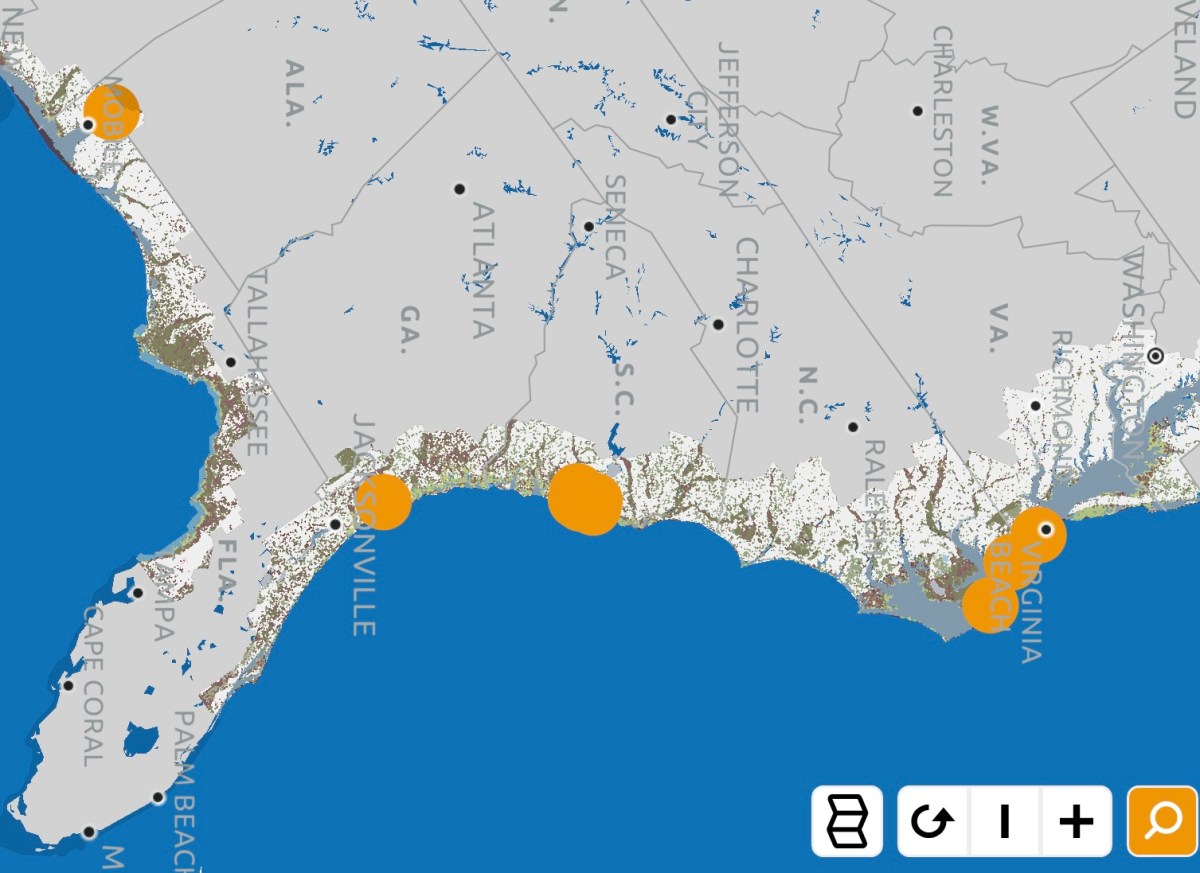
A new tool introduced today by the Southern Environmental Law Center (SELC), a non-profit and non-partisan organization dedicated to defending the environment, aims to deliver a clear view of the threats sea level rise poses to coastal communities in the Southeast through the use of an interactive mapping tool. “The project’s goal is to show citizens and decision-makers how the coast is changing,” the SELC said in a news release, “and how proposed infrastructure projects like highways, neighborhoods, and government or industrial facilities will fare as the water keeps rising and floods get worse.”

Visitors to The Changing Coast website will find an interactive map with overlays that enable them to visualize: 1. The flooding that will occur in their community as sea level rises; 2. Development projects that will be impacted by higher seas; 3. The locations of toxic Superfund sites that could contaminate neighborhoods and water supplies if they’re flooded by ocean water; 4. The locations of socially vulnerable populations who are most at-risk from sea level rise flooding and storm surges; 5. Wetland areas and floodplains that need to be protected from development to act as sea level rise floodwater buffer zones; and 6. Areas that are most at-risk from more powerful storm surges resulting global-warming-fueled stronger hurricanes and tropical storms.

Among the real-world examples of areas where the interactive mapping tool could assist real estate owners, government officials, planners and developers in coastal communities, the SELC offered the following:

  • “A proposed 9,000-acre housing development in Charleston could flood now with just a Category 1 hurricane. And rising seas could put parts of the development under water before the mortgages are paid off.”
  • “The roads leading to the proposed Mid-Currituck Bridge in North Carolina could be flooded on sunny days in the future if sea level climbs just two feet, rendering the span useless.”
  • “A 21-million-ton pile of toxic coal ash on the banks of the Mobile River in Alabama could likewise be threatened by a Category 2 hurricane, and that threat only increases as sea levels continue to rise. A breach could spread toxic ash into the river, through the Tensaw Delta, and into Mobile Bay.”

“The goal is to help guide decisions for the future, and to plan smart strategies to protect what exists now,” said Chris DeScherer, and SELC senior attorney.

The SELC’s interactive map is a valuable source of information that real estate owners, buyers and agents in the Southeast should use when considering property in coastal communities currently experiencing sea level rise flooding or at-risk of experiencing it in the near future. It would be wonderful if this powerful tool became available in other parts of the country.

Want to Fend Off Sea Level Rise Flooding? Start with Your Natural Gas Stove

A study released last week that concluded natural gas cooking stoves in the U.S. alone are leaking the equivalent of 500,000 cars-worth of greenhouse gases every year is a powerful reminder that real estate owners must play a role in combatting global warming and sea level rise flooding.

Researchers at Stanford University said in the study, published in the journal Environmental Science & Technology, that natural gas cooking stoves in over “40 million U.S. residences release methane — a potent greenhouse gas — through post-meter leaks and incomplete combustion.” They noted that three-quarters of the methane was released when the stoves were off. Around 80 percent of the methane leaked from loose couplings and fittings that connect gas pipes to stoves.

For years, the natural gas industry worked to convince the public that natural gas was a clean energy alternative. Using natural gas to produce energy does in fact release half as much carbon dioxide as burning coal to generate the same amount of energy. But scientists are increasingly concerned that the production and transportation of natural gas is leading to the release of dangerous amounts of methane — a more potent but shorter lived greenhouse gas than carbon dioxide — into the atmosphere.

A report published by Global Energy Monitor, a non-profit that monitors the fossil fuel industry, concluded that projects the oil and gas industry plan to fund to increase the use of natural gas globally would lead to the release of greenhouse gases in excess of all the coal fired plant put together. Ultimately, natural gas could keep us on track toward climate change catastrophe.

So what’s a homeowner to do? Climate groups are encouraging them to replace their natural gas powered stoves, hot water heaters and other appliances with electric appliances. For those who can’t afford to replace them, Rob Jackson, a professor of earth sciences at Stanford who was one of the stove study authors, told National Public Radio said they should use a wrench to tighten the connectors between pipes and stoves. The American Gas Association told NPR this work should only be performed by licensed professionals.

The point of this story is that people who own real estate in coastal communities that’s threatened by sea level rise flooding should certainly do everything they can to, such as raising seawalls and structures, to protect their property from rising waters, which is a symptom of climate change and global warming. But they also need to do everything they can to reduce the root cause of the problem, which is clearly any human activity that leads to the burning of fossil fuels and the release of greenhouse gases into the atmosphere.

If they have a gas stove, they need to replace it or make sure it’s properly maintained. Other steps they can take to help include ensuring that their property is weather-proofed and equipped with the most efficient appliances available today. Even switching off lights and electronics that aren’t being used can make a difference.

When We Play Politics with Climate Change, Everyone Loses

Two years ago, the first case of Covid-19 was identified in the U.S. Since that fateful day, 860 thousand Americans have lost their lives to the virus and millions have been sickened. Unfortunately, politics played a role in many of these casualties. We can’t afford let this happen when it comes to the climate change crisis and sea level rise flooding.

At the national level, President Biden took office a year ago. One of his stated goals was to pass the Build Back Better bill, which includes $555 billion to address climate change. Included in the legislation are projects that would promote renewable energy and clean transportation to help the country dramatically reduce greenhouse gas emissions by 2030.

Unfortunately, Build Back Better has been all but killed by Sen. Joe Manchin, D-W.Va, who has strong ties to his home state’s coal industry. Clearly his decision was made for his own political survival, not for the survival of the planet we all call home.

We’re seeing political shenanigans at the state level, too. In Florida, for example, Gov. Ron DeSantis has invested hundreds of millions of dollars in projects to protect real estate and critical infrastructure from sea level rise flooding. Among the projects being funded are new sea walls, pump stations, and stormwater sewers, along with the restoration of crumbling canal banks. This is good for the low-elevation state that’s extremely at-risk from global warming-fueled rising tides and more powerful hurricanes with stronger storm surges.

Unfortunately, Gov. DeSantis undermined his responsible approach to sea level rise flooding by injecting clearly partisan political venom when it came to addressing the root cause of sea level rise flooding: the burning of fossil fuels that release greenhouse gases into the atmosphere.

During the December news conference to announce his sea level rise infrastructure improvement initiative, the governor wouldn’t use terms like sea level rise and climate change, both of which could inflame his supporters — many of whom believe they’re hoaxes or minor problems. When a reporter asked Gov. DeSantis about global warming, he said, “What I’ve found is when people start talking about things like global warming they typically use that as a pretext to do a bunch of left-wing things that they would want to do anyways. And so we’re not doing any left-wing stuff.”

It’s pretty clear that the governor defines “left-wing stuff” as any actions that would reduce the nation’s reliance on fossil fuels.

Scientists say the only way to avoid the worst-case scenario of over eight feet of sea level rise by 2100 is to dramatically cut back on fossil fuel consumption. Gov. DeSantis’s approach to building defenses against sea level rise flooding but ignoring the root causes driving the tides ever higher, essentially dooms all of Florida’s coastal communities but especially those south of Lake Okeechobee to being potentially wiped off the map by the end of this century.

If the Covid-19 pandemic has taught us anything, it’s that playing politics with scientifically established facts during a global crisis is dangerous. For example, a National Public Radio analysis found that the counties that have suffered the greatest number of Covid-related deaths were those that were the most susceptible to misinformation from hyper-partisan politicians and media outlets. Basically, despite scientific evidence that vaccination saves lives, the misinformed residents chose not to get vaccinated and they paid with their lives at a number many times higher than those who got jabbed.

It has to be noted here that Gov. DeSantis has consistently downplayed the use of proven methods of reining in Covid-19 — vaccines, boosters, masks and social distancing — and pushed treatments that can be used AFTER people become infected. An LA Times analysis published during the heat of the delta outbreak late last summer, determined that his approach came at the cost of thousands of unnecessary deaths.

Taking a similar, non-scientific, politically-charged approach to climate change will have disastrous consequences for humanity today and for many generations to come. Without action to reduce the release of greenhouse gases today, we will certainly see a worsening of the droughts, wildfires, heat waves, extreme storms, and sea level rise flooding that have plagued the nation lately for decades to come.

The bottom line here is if we want to save our real estate and our way of life, we need to reach a consensus based on scientific fact, not political maneuvering, and invest in policies that will yield real results, real fast. If we don’t, we’re going to learn the hard way that when we try to gaslight the Earth, which is subject to basic laws of physics, we’re the one who will gets burned.

Another Florida City Passes a Seawall Height Ordinance to Fend Off Sea Level Rise Flooding

As sea level continues to rise and flood real estate, coastal communities are starting to wake up to the fact that a laissez-faire approach to seawalls won’t cut it any more. If the height and maintenance of seawalls isn’t regulated by cities and towns, there’s a chance floodwater is going to course over the lowest seawall in a series and flood the owner’s and neighbors’ properties, not to mention critical roads and infrastructure.

This week, the city commission in Delray Beach — located in southern Palm Beach County, Florida — responded to sea level rise flooding from inadequate seawalls along the Intracoastal Waterway. By a unanimous vote, the commission approved seawall ordinances similar to a breakthrough seawall ordinance passed two years ago in Broward County, Florida, that covered Fort Lauderdale and other coastal cities and towns.

Delray Beach’s new regulations close a gap that allowed private property owners free range over their seawalls, even if they were deficient and causing flooding problems for the surrounding area.

“The city is where the rubber meets the road,” Vice-Mayor Shirley Johnson said. “The county isn’t going to say this is going on. The state isn’t going to do it. And the federal government? They’re so far away they don’t even halfway know what’s going on, even though the Army Corps of Engineers does their level best. … So the city is left to do the work of enforcing, monitoring, being aware.”

The seawall regulations require the owners of new construction properties to build seawalls 4.2 feet over the base flood elevation as identified in FEMA Flood Insurance Rate maps. If the owner builds a seawall under that height, it must be designed to allow the construction of a height extender to bring it in line with the regulation.

City officials said they don’t plan to aggressively enforce the seawall regulations. According to the regulations, however, if flooding is reported from a deficient seawall, the city will require the owner to “demonstrate progress toward repairing the cited defect within 60 days of receiving notice from the city, and complete any necessary repairs within 365 days of receiving notice.” Property owners could face fines if they fail to meet the requirements.

In addition to the seawall height and maintenance requirements, the new regulations require sellers to disclose to buyers that the property of interest is subject to the new ordinances. The following language must be included in sales contracts: “This real estate is located in a tidally influenced area. The owner may be required by county or municipal ordinance to meet minimum tidal flood barrier elevation standards during construction or substantial repair or substantial rehabilitation to the property or the seawalls, banks, berms, and similar infrastructure or when required to abate nuisance flooding.”

With sea level rise continuing and, quite frankly, accelerating, more coastal cities and towns are bound to consider similar seawall regulations. Real estate sellers and owners and real estate agents in coastal areas need to stay aware of what’s happening in their communities as the regulations can have costly consequences.

The cost of building or repairing a seawall can run well into the tens of thousands of dollars or even higher, depending on the length of the seawall and the materials used. In addition, acquiring permits for seawall construction from federal, state, county and local governments can require a fair amount of paperwork and take longer than 365 day project completion limit.

Fossil Fuel Emissions Behind Global Warming and Sea Level Rise Are Roaring Back

The numbers are in, and fossil fuel emissions and global warming — drivers of sea level rise flooding — continue to head in a dangerous direction. According to the European Union’s Copernicus Climate Change Service , a non-partisan organization that tracks Earth’s temperature, 2021 was the fifth warmest year on record and the last seven years have been the warmest ever recorded. The organization also reported that the global concentration of carbon dioxide, the most plentiful greenhouse gas, continues to rise.

Adding to the troubling trend is the fact that greenhouse gas emissions rebounded at a rapid rate after the pandemic slump. The Rhodium Group released a report that found that US greenhouse gas emissions, which had been in gradual decline since about 2010, increased 6.2% in 2021. The good news, if there is any, is that 2021 levels were still 5% below those recorded in 2019.

The Rhodium group report said the switch back to coal burning for electricity — in response to high natural gas prices — was behind much of the increase in emissions. Road transportation as economic activity picked up also added to the emissions spike.

The link between fossil fuel burning, the release of carbon dioxide into the atmosphere, and the increase in temperatures on land and sea to ever-worsening sea level rise flooding, heatwaves, wildfires, drought, damaging storms and other climate calamities is well established. The setback in reducing the release of greenhouse gas emissions is stalling US efforts to combat global warming as is the inability of Congress to pass President Biden’s Build Back Better Act, which includes a $555 billion investment in renewable energy, electric cars and other measures. The critical bill is largely being held back by Joe Manchin a Democratic Senator from the coal state of West Virginia.

The US, of course, isn’t the only country contributing to Earth’s greenhouse gas load. China and India, which together account for two-thirds of global coal consumption according to the International Energy Agency (IEA), show no signs of slowing down. To make matters worse, both countries insisted that last year’s United Nation’s Climate Change water-down language regarding coal consumption. They would only agree to a “phase-down” in the use of coal instead of an accelerated “phase-out”.

Our home planet, of course, was not given a seat in the negotiations, but it is, nonetheless, speaking loud and clear. Through the rapid upward trend in climate catastrophes it’s telling us: Try to gaslight Earth, get burned.

Real estate buyers, sellers, owners and agents in coastal communities who are counting on rational environmental policy changes to protect their investments and livelihoods need to get involved and vote for candidates dedicated to a rapid reduction in the use of fossil fuels, like coal and oil, to turn this thing around.