Thank you for visiting my website! I'm an experienced and licensed drone pilot, photographer, videographer, real estate agent (voluntarily inactive), journalist and social media influencer. At my visual media company, Big Deal Media, I've used my skills to shoot stills and videos for businesses, real estate agents, private property owners, news outlets and event hosts. As The Step by Step Chef, I've published cookbooks and created hundreds of cooking videos for my StepByStepChef.com website that have attracted over 14 million views. I'm an honors graduate of the University of Southern California's School of Journalism with years of experience in marketing, advertising, public relations and public affairs. I look forward to putting my knowledge and experience to work for you!
Communities all along the U.S. coastline are scrambling to find ways to save coastal real estate from sea level rise flooding. Stinson Beach in California is now considering sand dunes as a way to keep rising seas from damaging or destroying over half of the town’s 775 homes by 2030.
An article published in the San Francisco Chronicle explains that Stinson Beach is already vulnerable to ocean flooding and has lost homes to the ocean during severe storms in the past. Sea level rise is making it likely even more homes will be lost in the near future, especially if nothing is done to hold back ever higher tides.
Marin County is exploring the possibility of building ecologically-correct sand dunes to protect the structures. County Supervisor Dennis Rodoni told the Chronicle that investing time and money in the dunes might be worth it, even if they provide only a temporary reprieve.
A study released in 2016 predicted that Stinson Beach would lose its beach by 2050. By the end of the century, up to 600 homes worth $1.5 billion would be flood-ravaged beyond repair. Marin County estimates that sand dune construction will cost up to $55 million, while more-permanent, less ecologically-friendly solutions, like seawalls, will cost up to $155 million to build.
Stinson Beach isn’t the only California coastal community facing this dire future. The state’s Legislative Analyst’s Office estimates that up to $10 billion worth of California real estate will be claimed by the sea by 2050.
Stinson Beach’s situation is a powerful reminder that real estate buyers and owners need to stay up to speed on the level of threat sea level rise flooding poses to their communities so they can make informed decisions regarding property that may only be viable for a few decades before its claimed by the sea.
When we think of sea level rise flooding, we think of salt water spilling across beaches, wetlands or sea walls and onto the land, but that’s not the whole story.
In many coastal areas, salty seawater sits in porous soil layers beneath the fresh water aquifer. As sea level rises, the salty seawater, which is denser than fresh water is forced inland where it pushes the fresh water table up toward the surface. This type of groundwater flooding is already creating a challenge for many coastal communities battling classic sea level rise flooding.
In Miami, for instance, some neighborhoods far from the coast are flooding because soils saturated from higher groundwater can no longer absorb heavy rains. The saturated soils are also rendering septic systems inoperable as wastewater that’s carried out into leaching fields cannot be absorbed by already saturated soils.
According to an article by Kendra Pierre-Louis published in MIT Technology Review (“How rising groundwater caused by climate change could devastate coastal communities”) rising groundwater presents a “potentially catastrophic” threat to homes and infrastructure. “Roadways will be eroded from below,” she writes, “septic systems won’t drain, seawalls will keep the ocean out but trap the water seeping up, leading to more flooding. Home foundations will crack; sewers will backflow and potentially leak toxic gases into people’s homes.” Pierre-Louis explores the challenges in great detail in her excellent piece.
Experts say Miami (and all of South Florida, for that matter) isn’t alone in confronting this threat. Kristina Hill, an associate professor at the University of California, Berkeley, told the Pierre-Louis that flat coastal areas with a type of geology that allows water to move easily through the ground are at risk. The list also includes Oakland, California, Brooklyn, New York, Mountain View, California and Washington, DC.
Of great concern here is that cities might spend billions of dollars on seawalls, elevating streets and properties, and other efforts to combat classic sea level rise, but if they don’t consider the threat posed by the rising water table that can defeat those measures from below the investment could be a colossal waste of time and money.
Buyers of real estate in coastal communities that are vulnerable to this type of flooding need to understand that flooding from beneath poses as great a threat to their investment as flooding on the surface. They need to make sure that properties of interest — and nearby properties and roads — have not experienced groundwater flooding and are not at risk of experiencing it during the period they intend to own a property. They also need to know if the septic system (if they’re not hooked up to municipal service) is operational, if pipes providing water and sewer service are in good shape, what government officials are doing to address the problem, and how much any efforts to mitigate the problem will contribute to their water and sewer bills and taxes.
Ultimately, with the enormity of the land area at-risk, combatting groundwater rise will likely prove as — if not more — difficult than fighting classic sea level rise. The best choice, therefore, is to prevent the sea level/groundwater rise itself by adopting renewable energy sources that slow and stop the global warming that’s driving it.
Just as a group of scientists is reporting that global warming threatens to cause the collapse of the so-called “doomsday glacier” in Antarctica — which could add a catastrophic two to 10 feet of sea level rise — the last thing owners of coastal property under threat of sea level rise flooding need to hear is that Senator Joe Manchin intends to vote no on President Joe Biden’s Build Back Better bill.
Sen. Manchin, a Democrat, stated his intention over the weekend, which brought passage of the bill to a screeching halt. Without Sen. Manchin’s support, there’s little chance the bill, which faces overwhelming Republican opposition, will pass in the evenly divided Senate.
It’s no surprise that Sen. Manchin, sent to Washington, DC, by the coal state of West Virginia, is opposed the bill. It includes billions of dollars to develop clean energy resources. Unfortunately his short-sighted position will have long-term negative implications for the U.S.’s ability to reach President Biden’s goal of cutting greenhouse gas emissions by up to 52% by 2030.
The U.S. is Earth’s second worst emitter of greenhouse gases. Without a substantial reduction the burning of fossil fuels for electricity, transportation and industry, the world will continue to warm at an ever-accelerating pace and sea level rise will continue to follow the trend.
A foot of human-caused sea level rise is already forcing coastal communities to invest hundreds of millions of dollars to protect real estate, critical infrastructure and their local economies — an investment that’s sure to rise into the trillions of dollars nationally in the coming decades. The failure to also aggressively address the root cause of global warming and sea level rise through the Build Back Better bill is placing us firmly on the path to the worst case scenario of sea level rise flooding and other climate change catastrophes, such as droughts, raging wildfires and stronger, more damaging storms.
The bottom line here is owners of coastal real estate need to start voting for candidates dedicated to fighting climate change to protect their investment and their way of life.
As the planet continues to warm — the last seven years have been the hottest in recorded history — ever-quickening glacial melt and the expansion of ocean water as it heats up is causing sea level rise to accelerate. The foot of sea level rise that has occurred in the last hundred years or so that’s already driving damaging coastal flooding, however, will seem minuscule if researchers are right and the Thwaites glacier, Earth’s widest, slides off Antarctica and into the sea.
Scientists warned at a news conference in New Orleans this week that global warming has caused the Thwaites glacier to double its rate of melting over the last 30 years. But they say the glacier poses an even greater threat of causing rapid sea level rise if warm ocean water causes it to rapidly deteriorate.
According to researchers, warm ocean currents are causing the glacier’s seaborne section to melt from the bottom, where it comes in contact with a rock shelf that essentially allows it to act as a cork that prevents the land-based section of the glacier from rapidly flow into the sea. Just as disturbing, they’re seeing cracks on the top of the glacier growing so fast they predict it could disintegrate in as little as five years.
If this were to happen, it would set off a chain reaction that could cause sea level to rise several feet. “The glacier is the size of Florida or Britain and currently contributes four percent of annual global sea level rise,” the researchers said in a report. “If it does collapse, global sea levels would rise by several feet–putting millions of people living in coastal cities in danger zones for extreme flooding.”
The dire report was released by the International Thwaites Glacier Collaboration, a team of nearly 100 scientists funded by the U.S. National Science Foundation and U.K. Natural Environment Research Council. Lead researcher Ted Scambos, a senior research scientist at the Cooperative Institute for Research in Environmental Sciences, said, “If Thwaites were to collapse, it would drag most of West Antarctica’s ice with it. So it’s critical to get a clearer picture of how the glacier will behave over the next 100 years.” Scambos said Thwaites alone holds enough water to raise sea level by over two feet, but, if it takes surrounding glaciers to sea with it, sea-level could rise by up to 10 feet.
To protect their financial future, buyers and current owners of coastal real estate need to stay informed about the threat posed by the Thwaites Glacier and other drivers of sea level rise and sea level rise flooding.
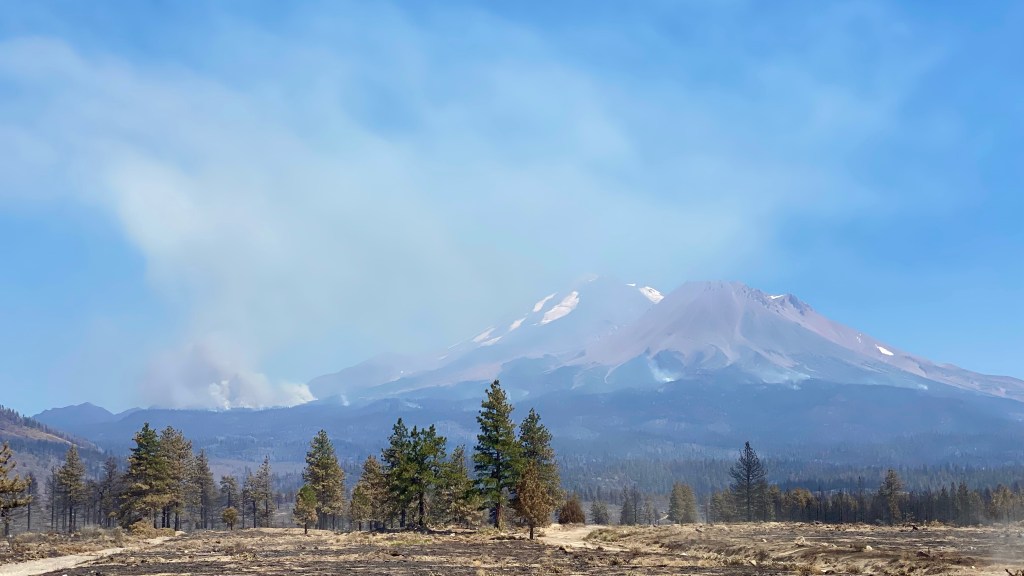
Mount Shasta, California, unusually snow depleted and ablaze — July 2021
While it was encouraging to see over 100 world leaders attempt to grapple with the enormous challenges posed by human-driven climate change and global warming at this week’s COP26 (talk about a horrible acronym that does nothing to promote public understanding of the climate change crisis) summit in Scotland, the end result is, well, kind of depressing.
The meeting was hobbled from the start because leaders of two top-four greenhouse gas polluters — China, the worst offender, and Russia, the fourth worst — didn’t attend. (It’s important to note here that the US is the second worst generator of fossil fuel emissions and India is the third). Without China and Russia rolling up their sleeves and assisting in creating a coordinated, unified and overwhelming response to the climate change threat, the best the summit could accomplish was to commit to reducing methane emissions — methane is a much more potent greenhouse gas but it doesn’t remain in the atmosphere and accumulate like carbon dioxide, the main driver of climate change — and stop deforestation by 2030. Both are certainly helpful goals, but they fall far short of the aggressive approach that’s actually needed today to protect humanity and wildlife by fending off even worse heatwaves, drought, tropical storms, wildfires, and inland and coastal flooding than we’re already witnessing today.
Some leaders have tried to label the conference a great success, but their assurances seem like gaslighting, essentially intended to assure the public that they are taking adequate steps to address climate change and reduce the climate change disasters we’re witnessing all around us when the reality is they’re falling far short of where humanity needs to be to avert even worse catastrophes. People can accept the gaslighting and merrily go along their way — many have certainly done it with Covid-19 — but, unfortunately, Earth, a product of basic astronomy, geology, chemistry, physics isn’t buying the lies. It can’t. As greenhouse gases created by the burning of fossil fuels continue to accumulate in the atmosphere, the planet will do exactly what science dictates and continue to warm and warm and warm.
In the weeks leading up to the summit and while it was actually being held, I read way too many opinion columns by politicians, pundits and even a few scientists that tried to reassure the world that everyone is over-reacting to climate change and that the problem will ultimately be solved by technology and other measures, which it’s important to note here, apparently don’t exist yet because greenhouse gas emissions keep increasing along with global temperatures, sea level rise flooding and other climate-related disasters. Their words reminded me of the reassurances we’ve been given by some politicians, pundits and even a few scientists that the Covid-19 pandemic could be solved without masks, social-distancing and even vaccinations. To me, their words are nothing but lies.
The truth about Covid-19 is that masks, social-distancing and vaccinations have saved lives. In fact, Dr. Deborah Birx, one of ex-president Trump’s Covid advisors, recently estimated that Covid-19 deaths could have been reduced by up to 40% in 2020 if the White House had consistently stressed the importance of mask-wearing, social distancing and testing before the vaccine was rolled out in 2021.
Similarly, the Los Angeles Times published an article in October that estimated my home state, Florida, which has lost nearly 60,000 residents, could have saved 18,000 lives if it had implemented the same strict infection prevention measures as California. Whereas California would have lost 34,000 more people if it followed Florida’s lax example.
The bottom line is a lot of Covid-19 deaths and misery could have been prevented if politicians, pundits, and even a few scientists had paid attention to the facts instead of gaslighting the public with dangerous anti-science statements that left the public angry, divided and vulnerable to infection. (A truly frightening aspect of all of this is that either of two leading spreaders of Covid-19 false information, Ex-president Trump and Florida Governor Ron DeSantis, may actually be elected president in 2024, which is sure to lead to four more years of anti-science climate chaos and wasted opportunity when we’re rapidly closing in on the point of no return.)
The climate change situation is no different than the Covid-19 debacle, but the stakes are much higher. As Earth is burning, the gaslighters are calling on us to save the silver — save the fossil fuel companies, save energy profits, save the power structure, save the wealthy’s standard of living, save the status quo — when what’s really needed is a concerted effort by nations and individuals to put out the flames using aggressive and innovative approaches NOW. The reality is if we don’t save Earth, if we don’t save The House — we — the rich, the poor, and those of modest means — will have no other place to go. We, in short, will perish in the flames.
Earth’s 4.5 billion-year-old geologic record is jam packed with species that perished in mass extinctions because they couldn’t adapt to environmental changes. It would be utterly insane to assume it can’t happen to us. The only difference between us and the extinct species is, they didn’t willingly create the circumstances that led to their own annihilation. We are.
At some point, we the people need to recognize in unison that the gaslighters who are insisting climate change isn’t a problem — that we can easily adapt to a hotter planet or save it through hail-Mary pass technology instead of taking concrete steps to reduce greenhouse gas emissions right now — are leading us to ruin.
The greedy, the power-hungry, and the just plain ignorant among the gaslighters don’t surprise me. They’ve always been around. What surprises me is the normally level-headed politicians, pundits, and even a few scientists who are insisting that we all engage in climate change denial and/or wishful thinking that technology without radical change in our lifestyles, our approach to managing the earth, and yes, some shared financial pain, can save the planet. They act like climate change, global warming, and sea level rise are problems so far off in the future that we have plenty of time to deal with them when we clearly don’t.
As an avid traveler, camper and hiker, I have to wonder, if the gaslighters ever, you know, actually go outside? I do. And I can tell you in just a few short decades, Earth has become a very different place than the planet I grew up on.
Last summer, I took a road trip across America to see what climate change actually looks like. What I saw with my own eyes confirmed what the vast majority of climate scientists have concluded: the climate is changing negatively due to human created global warming, and it’s going to get far worse if we don’t take drastic steps to stop the the process today.
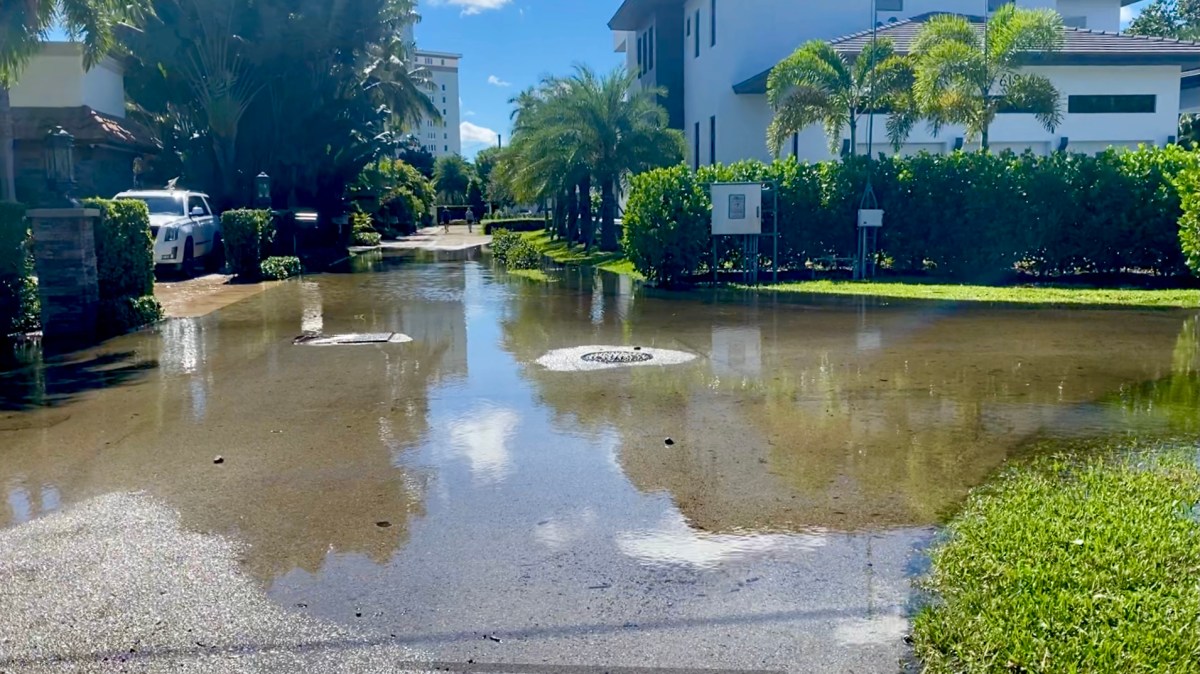
South Florida and coastal communities everywhere are already battling sea level rise flooding.
My trip started in South Florida, where coastal communities are already spending billions of dollars trying to fend off repeated bouts of sea level rise and storm surge flooding. From there, I drove north and tent camped my way up the Appalachians and Smokies, which are experiencing extreme flooding events from more powerful and long lasting hurricane and tropical storm remnants as well as global warming-supercharged local rainstorms.
After that I made a beeline west across the country’s breadbasket, which has been experiencing decades of yo-yoing extreme flooding or drought, and headed up into the Rockies, where I was immediately overcome by wildfire smoke. To avoid the smoke and the early-season wildfires that were generating it, I headed down to Utah’s Canyonlands, where Lake Powell was so drought-stricken that boat ramps ceased football fields short of the water’s edge.
Then it was off to California, where I saw houses in Pacifica at risk of tumbling into the ocean from sea level rise eroded cliffs. After that, I drove up to Lassen Volcanic National Park and got a whiff of wildfire smoke that portended the disaster to come. Half the park’s forests were consumed by flames shortly after I left.
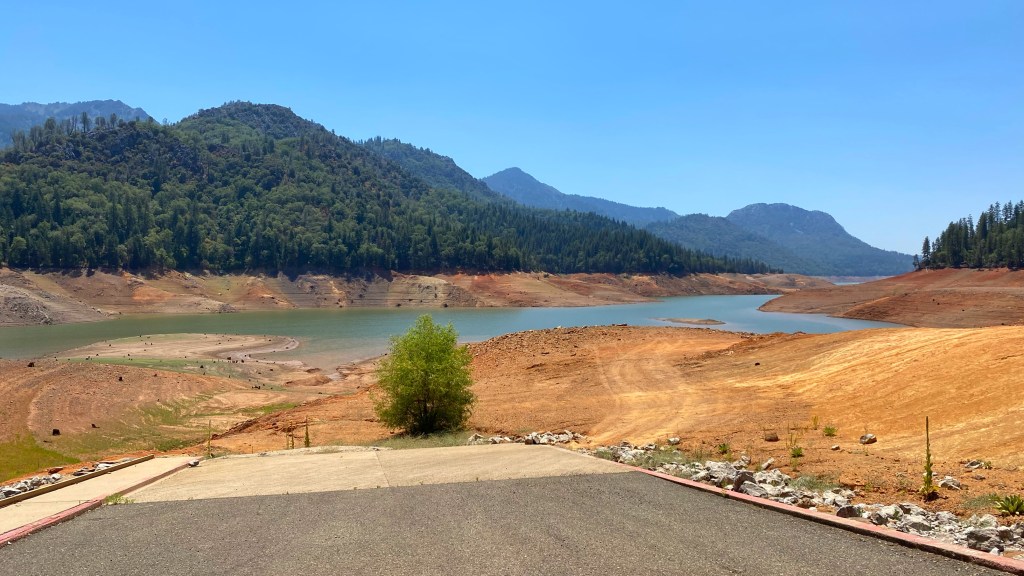
Next, I drove northwest to Mount Shasta, which, was quite the shocking sight. An intense heatwave had melted away most of the mountain’s gorgeous snowcap and the northeast flank was ablaze. Unable to camp there, I decided to head north toward Oregon. Within an hour, I suffered a second shock: As I drove the I-5 bridge over Lake Shasta, I was nearly blinded by deep, exposed orange and yellow banks. The drought-stricken lake was at about 40 percent capacity, and, just like Lake Powell, the boat ramps ended in dirt.
Climate change is driving extreme drought in the west. Many reservoirs were below 1/2 capacity. — Lake Shasta, California, July 2021.
During my drive further north into Oregon, I passed the towering atomic mushroom cloud signature of the raging Bootleg Fire. And farther up in Washington State I witnessed Mt. Rainier’s snowpack and glaciers melting away. The Olympic Peninsula was no escape either. The glaciers are melting away there, too, and sea level rise flooding and erosion are forcing a tribe of indigenous people to move their historic town further inland.
Burned out forests have replaced lush green scenery in long stretches of the American West.
All of these sights were shocking to see. Equally shocking were seemingly endless stretches of blackened forests that had replaced the lush greenery I was used to seeing in the past.
In all of human history, we couldn’t have picked a worse time for people to try to gaslight the public for profit and political power. We need more intelligence, more science, more climate change policies and projects, more unity, more enthusiasm, more strength and more will to rein in climate change, global warming and sea level rise, not a bunch of false reassurances that somehow things will work out.
The truth is people can gaslight people all they want, but Earth, the ultimate judge and jury, can’t be gaslighted. Keep trying to gaslight Earth and we will be the ones who get burned.
I don’t want to leave this column with only a depressing message. I still believe we can take on the challenges posed by climate change, but it requires us all to get involved beginning today by:
1. Electing only those leaders who are dedicated to fighting against climate change;
2. Educating ourselves and our friends and family about the threat posed by climate change, global warming and sea level rise flooding;
3. Using energy wisely by weatherizing and increasing the energy efficiency of our homes and businesses, driving only when necessary and consolidating many trips into one, and turning off tv’s, computers and appliances when we’re not using them;
4. Buying the most energy efficient vehicle we can afford and taking public transportation and hopping on our bikes or walking whenever possible;
5. Eating a more plant-based diet, which cuts down on the release of methane in the production of meat, and doing everything we can to avoid food waste;
6. Buying durable products that we need not a bunch of frivolous junk that serves no purpose; and
7. Seeking other ways to reduce our energy consumption and pollution.
To avoid falling into climate despair and paralysis, I’m actively implementing the steps I’ve outlined above. I hope you will, too.
If a picture is worth a thousand words, then the collection of photos Climate Central — a nonprofit news organization — touched-up to show what sea level rise flooding will do to coastal cities around the world if we don’t cut back on greenhouse gas emissions should leave you downright speechless.
The environmental group recently published before and after photos of the sea level rise flooding 184 sites from Dhaka Bangladesh to Charleston, South Carolina and everywhere in between will experience at varying levels of global warming from the preferred target of 1.5 degrees centigrade all the way up to 4 degrees centigrade. The collection is published under the title “Picturing Our Future” and tagged “Climate and energy choices this decade will influence how high sea levels rise for hundreds of years. Which future will we choose?”
Researchers used new global elevation data from a study titled “Unprecedented threats to cities from multi-century sea level rise” published on the IOPScience website to generate the photos. The study itself states “a portion of human-caused carbon dioxide emissions will stay in the atmosphere for hundreds of years, raising temperatures and sea levels globally.” They go on to explain that globally, we’re falling short of what needs to be done to avoid the worst case sea level rise flooding scenario. “Most nations’ emissions-reduction policies and actions do not seem to reflect this long-term threat,” they wrote, ” as collectively they point toward widespread permanent inundation of many developed areas.”
It’s critically important to note here that sea level rise isn’t a future threat, it’s happening now in coastal cities across the U.S. and around the world. In the US, federal, state and local government entities are already investing billions of dollars in funds to raise seawalls, roads, water and sewer systems, and other critical infrastructure. And these efforts are seen as merely a tiny fraction of what will actually be needed to fend off floodwaters in the years and decades to come. Many real estate owners in coastal areas that are experiencing flooding are already having to pay out of pocket to raise seawalls and elevate their houses. In areas that can’t be saved, some states are offering buy-outs to property owners.
The bottom line is today and tomorrow we will be dealing with sea level rise flooding. The decisions we make today will have short-term and long-term implications. Educating yourself on sea level rise flooding has never been more important.
Sea level rise and sea level rise flooding have been gradually increasing for decades, but scientists are predicting a noticeable jump in the next decade. Why? A predictable wobble in the moon’s orbit will place Earth’s tide-driving companion closer to the planet from 2030 to 2040. A closer moon means higher high tides and lower low tides.
When you combine the moon’s stronger gravitational pull on the oceans with climate change-driven sea level rise, we can expect to see even more sea level rise flooding than we’re now witnessing in coastal communities. In fact, experts are predicting the moon wobble will result in sea level rise flooding conditions that were not expected until the end of this century. For example, scientists estimate San Francisco will experience five times more high-tide flood days in the next decade than it does now.
To arrive at their disturbing conclusion, NASA researchers reviewed data from tide gauges located in coastal communities in every state and territory but Alaska, which, due to its position on the globe, is not expected to face higher tides due to the moon wobble. The research was published in the journal Nature Climate Change.
Buyers and owners of real estate currently experiencing sea level rise flooding or located in communities that flood need to add the wobble into their long-term property ownership decisions. Flooding is already forcing the government and property owners to spend billions of dollars to fend off floodwaters and protect critical infrastructure. A sudden leap will only worsen property damage and result in higher outlays for maintenance, taxes and insurance.
Anyone who doesn’t believe climate change, global warming, and sea level rise are real needs to see the shocking sights I saw during a summer road trip across America.
From early July through early August, I tent camped my way up the Appalachian Mountains, across the mid-part of the country, and all over the West, including Utah, Nevada, California, Oregon, Washington, Idaho and Wyoming. In ten short weeks, I saw:
*A Lake Powell, Utah, boat ramp high and dry due to the mega-drought;
*Houses in Pacifica, California, dangerously close to toppling into the Pacific Ocean because of sea level rise-driven erosion;
*Bone dry Lassen Volcanic National Park, California, before a wildfire burned through half its forests;
*Mount Shasta, California, nearly snowless with smoky fires burning on its stark gray flanks;
*The drought-stricken Lake Shasta reservoir so low the exposed orange and yellow banks were blinding;
*An enormous mushroom cloud billowing over the Bootleg Fire — Oregon’s third worst wildfire ever;
*Mount Rainier, Washington, snow-starved, its glaciers melting due to an unusual early summer heatwave;
*An elementary school being built inland in La Push, Washington, on the Olympic Peninsula because sea level rise and stronger Pacific storms threatened the historic coastal village; and
*Endless, hazy wildfire smoke filled skies.
Scientists have accumulated an enormous body of research that says the heatwaves, mega-drought, stronger, more damaging storms and wildfires, sea level rise, receding glaciers, and depleted reservoirs we’re seeing today are all related to climate change and global warming, which is going to get progressively worse in the decades to come. What I saw with my own eyes says they’re right.
The real question now isn’t the science and it isn’t whether or not climate change is harming the world around us today. The science is sound and climate change/global warming is hitting us on many fronts today. The real question now is do we have the will to act to save the planet for our generation, future generations, and the wildlife that deserves a functioning Earth as much as we do.
In this video, I take you with me on my shocking American climate change road trip and propose five steps we can all take today to fight this global threat:
Only elect candidates who believe we need to combat climate change now.
Money talks. Buy from companies that not only talk about the need to fight climate change but are taking action now.
Buy the most energy efficient vehicles we can afford.
Buy the most energy efficient homes and businesses we can afford or take steps, and practice energy conservation by switching off TVs, computers, lights and other electronics when we’re not using them.
Eat a mostly plant-based diet to help reduce the amount of energy needed to produce food.
Watching the planet go up in flames isn’t an option. We all need to act NOW.
As a long-time resident of South Florida, this is the most difficult post I’ve had to write for SeaLevelRiseRealEstate.com. My condolences to the family and friends of those who lost their lives in the tragic Surfside, Florida, high-rise building collapse. May they find comfort in the memories of their days together.
Although the investigation into the disaster has barely begun, structural engineers analyzing potential causes have suggested that rainwater and maybe even sea level rise-driven, salty ocean floodwater that pooled on a flat pool deck may have damaged the building’s concrete and steel reinforcement structure to the point that the pool deck collapsed into the garage and brought the floors above with it. For a few years, structural engineers had warned the condo board that the water damage needed to be fixed immediately. The condo board says that it did its best to convince the residents that they needed to fund the repairs, but it was a slow process. Investigators will have to sort out the details.
Regardless of the ultimate cause of the catastrophe, the lessons are clear for buyers and owners of real estate in coastal communities. They need to practice due diligence when evaluating coastal properties.
When buyers are purchasing condos, townhouses or homes in seaside communities, they need to have the structures fully evaluated by licensed and experienced home inspectors. When they receive the inspection report, they need to read it in detail and ask the inspectors to explain any deficiencies and whether it’s still worth purchasing the subject property.
In cases that involve homeowner’s associations or condo boards, buyers need to treat the interview process as not only an opportunity for the board to become familiar with them but as an opportunity for them to find out if the board is managing the property well. To do this, buyers need to get a copy of financial records and annual reports and actually read them to see if the association is properly funded or burdened with debt and holding enough reserves to cover the cost of anticipated maintenance. They also need to find out if the property is properly maintained, if there are any ongoing maintenance issues, and if there are any anticipated maintenance projects — and how much each resident will have to pay toward the projects. Special assessments can cost each owner tens of thousands of dollars. Another crucial part of this due diligence process is asking the board for a copy of recent property inspections, whether they were conducted by a private firm or city department.
Both salt-water infused rain and sea level rise flooding can damage structures. Buyers need to find out in writing from sellers or the board whether or not the property is subject to sea level rise flooding now or will be in the near future. They also need to know what, if anything, is being done to control the problem and how much it will cost.
Buyers aren’t the only ones who need to practice due diligence. Owners of coastal real estate need to be pro-active when it comes to the maintenance of what is essentially their home. They have to get involved either by becoming board members or becoming active participants — and problem solvers — in the board’s deliberations. When a structural engineer identifies a problem that needs to be addressed immediately, they need to pressure the board and other residents to get on board and get it repaired.
Owners also need to pay attention to the threat sea level rise flooding poses to a property and what the board intends to do to address it. If fellow residents aren’t interested in properly maintaining a building, it might be time to sell.
Over the years, I’ve rented condos in buildings that were well managed and some that weren’t. One condo building I lived in a block from the ocean was so poorly maintained that saltwater intruded through the stucco exterior causing so much damage practically the entire structure had to be replaced to make the building habitable. Another building I’ve lived in was so well managed that the owners fixed slight deficiencies before they caused any noticeable damage. Condo and homeowner’s association fees for some buildings might seem high on the short-term, but if the money is being used to avoid costlier problems down the road, the investment is clearly worth it.
Over the past few months, I read an article in the Charleston Post and Courier that said one of the first questions buyers in Charleston — a city that’s being impacted by flooding from sea level rise, storm surges, and heavy rain — were asking is “Does this property flood?” A real estate agent quoted in a Miami Herald article said agents in her city rarely if ever asked that question — this despite Miami being ground zero for sea level rise flooding. The Surfside tragedy will likely result in buyers being much more likely to ask questions regarding flooding and building maintenance. Condo and homeowner’s association boards and owners in their building are going to have to be much more pro-active regarding building maintenance to protect their investment and their lives.
Flooding is the most frequent and costly natural disaster in the U.S. Unfortunately, it’s also among the hardest to detect for real estate buyers. That’s due to the fact that between bouts of flooding — including sea level rise flooding — properties, roads and neighborhoods can appear high and dry.
The sea level rise real estate quiz video is meant to show buyers how hard it is to tell where flooding has occurred. The videos clips with dry properties were recorded during the dry season in South Florida. The clips with flooding taken at the same locations were recorded during fall king tide season, when the Earth, Sun, and Moon were in a certain proximity that promotes higher than normal tides.
A small but growing percentage of properties located right along the beach and Intracoastal Waterway flood several times a month from August through December. This type of sea level rise flooding is occurring in many communities along the Atlantic, Gulf, and Pacific coastlines. The situation is getting worse every year as the ocean continues to rise.
Clearly, buyers purchasing coastal properties need to ask sellers, real estate agents, neighbors, public officials, and flood insurance providers if the property of interest experiences sea level rise flooding. The laws governing the disclosure of flooding vary widely from state to state, so buyers need to consult multiple sources to get a complete picture before submitting a real estate contract.





 Sea Level Rise Flooding Information for Buyers, Sellers, Owners, and Real Estate Agents
You must be logged in to post a comment.