
The Destructive Relationship Between Sea Level Rise and New Coastal Real Estate Development

Living in a coastal community that’s experiencing sea level rise flooding, I’m amazed at the hundreds of millions of dollars of new commercial and residential real estate being built in neighborhoods that are flooding today or that will soon be subject to floodwaters as the seas continue to rise.

When I ask my real estate agent friends what they think about the situation, they are always quick to remind me that Florida’s economy is heavily reliant on new building projects and the jobs, investment and tax dollars they bring for its very survival.

Many cities and towns along he Atlantic, Pacific and Gulf of Mexico coastlines are equally addicted to new development to keep their economies rolling and their governments solvent. There is, however, clearly a downside to this relationship.

As sea levels continue to rise, those same coastal cities and towns are going to have to start to invest heavily in flood mitigation strategies, such as raising roads and water and sewer pipes, building or raising sea walls and installing pumps. In some cases, they may even have to buy-out homes and whole neighborhoods that flood repeatedly. When this day arrives — and it has already arrived in parts of the Florida Keys and other vulnerable locations — what seemed like a good idea today — allowing hundreds of millions of dollars in new development in areas vulnerable to sea level rise — will have enormous costs to taxpayers and property owners.

Taxpayers will have to pay the tab to protect the expensive new flood mitigation projects. And the higher taxes to pay for those projects, combined with the higher insurance premiums that go hand-in-hand with sea level rise flooding, could cause property values to plummet.

Linda Shi, an assistant professor in Cornell University’s department of city and regional planning, wrote an op-ed titled “The fiscal challenges of climate change” for the Boston Globe. In it, she explains the challenge posed by new coastal development in the age of rising seas. She studied the Massachusetts coastline in detail and discovered:”Statewide, 40 percent of local revenues come from property taxes; along the coast, 60 percent; and in some coastal suburbs, 70-80 percent. State expectations that local governments self-finance most of the services they provide inevitably incentivize continued development wherever possible, placing coastal sites and cities on a collision path with rising seas.”

Shi says the negative cycles could be reversed if cities and states included fiscal considerations into sea level rise flooding vulnerability assessments. She also said regional land-use planning agencies and non-governmental organizations could help by evaluating “how climate change affects local budgets, how fiscal vulnerability and adaptation choices impact the region and vice versa.” Their input would help communities to decide where to allow new real estate developments to minimize the eventual costs that arise due to sea level rise flooding.

The future costs of placing new developments in or near sea level rise flood zones is an important issue to consider today. Making informed decisions will protect subsequent generations from the high cost of protecting or decommissioning billions of dollars worth of real estate our generation knew was at-risk before ground-breaking shovels were turned.
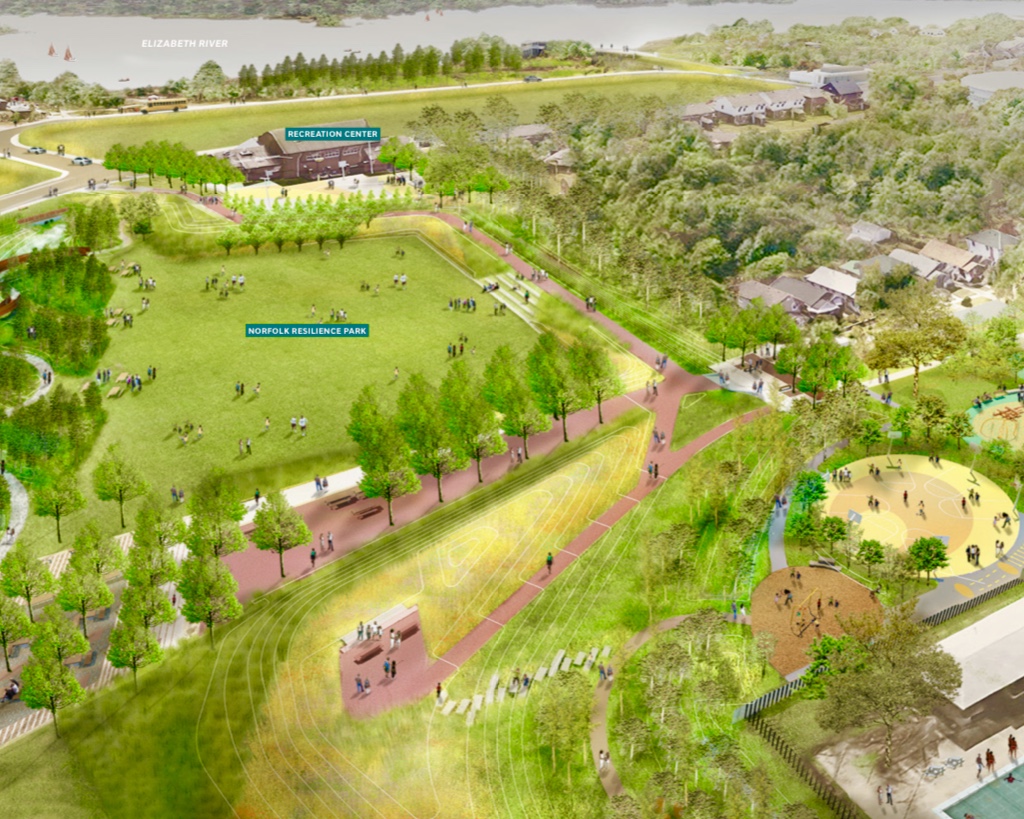
Norfolk Neighborhood Breaks Ground on Sea Level Rise Diversion Project

When confronted by sea level rise flooding, neighborhoods have a choice: Try to hold the waters back, move out of the area, or divert the water into areas designed to accommodate floodwaters.

Virginia Gov. Ralph Northam, Norfolk Mayor Kenneth Alexander and community leaders recently broke ground on a project that takes the last approach to cope with sea level rise flooding. Resilience Park, part of the Ohio Creek Watershed Project, will create a green space to store and absorb floodwater. The project also includes a coastal flood berm, restored tidal creek wetland, and sports and recreational facilities.

A major plus to residents is that that project also includes a walking path that will connect two predominantly African American neighborhoods. “The Ohio Creek Watershed Project is an example of the kind of work we need to do to protect lives, property, and economic opportunity in Hampton roads, and the innovation that will help us build a safer, more sustainable, and resilient Virginia for future generations,” Gov. Northam said.

Virginia is using $112 million of a $120 million U.S. Department of Housing and Urban Development grant to fund the project.

Beachfront Real Estate Could Vanish in Some Areas Due to Sea Level Rise

Global warming and the sea level rise that’s coming with it could wash away over almost half of the world’s sandy beaches by 2100. That’s according to a study published this week on Nature Climate Change.

The loss of the beaches would have enormous economic implications. Beaches provide a barrier that protects real estate and whole cities from storm surge. They also create recreational opportunities that fuel tourism.

Scientists say stronger storms and manmade alterations, such as the construction of jetties and seawalls, are speeding up erosion. Add sea level rise to the mix and the situation becomes even more dire.

The outlook isn’t hopeless, however. The researchers say if humans cut down on greenhouse gas emissions, sea level rise could slow and shoreline retreat could be reduced by nearly 40 percent.

Buyers purchasing beachfront real estate need to consider beach erosion and how it could impact their property before they submit an offer.

The State of Septic Systems Has to be Considered when Purchasing Coastal Real Estate Under Pressure from Sea Level Rise

When purchasing real estate in coastal areas, buyers need to ask whether a property of interest is has a septic system and how well its operating. This question is especially important now that sea level rise is causing thousands of septic systems to operate less efficiently and even fail — sometimes well inland from the ocean.

Most septic systems take household waste water and pipes it into a holding tank buried in the yard. There, the solids sink to the bottom and the liquids flow into a leaching field where microbes in the soil treat and filter out the remaining impurities. Ideally, after that, the treated, purer water eventually flows into groundwater, nearby rivers and streams or the ocean without a problem.

Sea level rise disrupts the process by forcing the water table to rise. This saturates the soils that are needed to treat and filter out the impurities. As a result, the septic system outflow can pollute yards and contaminate groundwater and water on the surface.

When this happens, property owners usually have two choices: 1) Invest in improvements — such as raising the septic system if that’s feasible and adding more dirt to the system — or 2) Abandoning the septic system and tying into a city wastewater treatment system.

To protect themselves from unexpected expenses, real estate buyers in coastal areas need to know if a property is served by a septic system or already tied into the municipal sewer system. If the answer is septic, they need to have a home inspector determine if the system is operating well and how long it will be effective as seas continue to rise.

Sea Level Rise Poses Challenges for Commercial Real Estate

Residential real estate isn’t the only sector facing challenges from the threats posed by climate change and sea level rise flooding. Commercial real estate is under pressure, too.

According to a report recently released by Dechert LLP, a global law firm that advises corporations, financial institutions, sovereign states and wealthy individuals, “Climate change is forcing the commercial real estate industry to re-think the effectiveness of flood insurance that developers, lenders and investors have relied on for decades.”

The report notes that extreme weather and sea level rise flooding are pushing the commercial flood insurance system “to a breaking point.” Specifically, the report notes that 14 weather and climate disasters in the United States resulted in $91 billion in damages. Each event had losses exceeding $1 billion mostly from damage to residential and commercial real estate.

Among the challenges faced by the commercial real estate sector discussed in the report:

1) The National Flood Insurance Program (NFIP) administered by Federal Emergency Management Agency is financially unstable. The program is now running over $20 billion in the red, and it relies on government bailouts to continue to operate. Its authority to operate is due for renewal next fall. If it’s not renewed the report says, “The potential for disruption is most concerning for property owners in special flood hazard areas seeking mortgages from federally-backed entities and federally regulated banks because flood insurance is legally required for these loans.”

2) FEMA’s flood maps, which are supposed to identify a commercial property’s exposure to flood risk, are notoriously outdated and they do not consider sea level change or increased flooding estimates. “This has led to costly and catastrophic errors,” the report says. “For example, in 2018, at least 140 Florida homes were demolished following the destruction of Hurricane Michael. However, the relevant FEMA flood map reflected that the properties were in flood zone X (0.2% chance of flood in any year) and flood insurance was not required.”

3. Flood insurance only covers damages, not loss of value. The report says this is a problem because as properties become increasingly vulnerable to flooding, the will inevitably lose value over time. “The worst-case scenario here is particularly bleak,” the report says. “Billions of dollars of real estate will be underwater not only in terms of their market value being less than the outstanding mortgage debt, but also because these properties will be at greater risk of someday being literally underwater. Refinancing these mortgages and insuring these properties will undoubtedly become more challenging each passing year.”

The report goes on to explain how uncertainty in the flood insurance market is leaving the the commercial real estate finance industry without a “uniform strategy to underwrite the increased frequency and severity of flooding due to climate change.” The report says the public and private flood insurance industry “will soon be forced to adjust to face the environmental and economic realities of a country more prone to frequent, catastrophic and repeated flooding.”

The authors predict that the commercial real estate finance industry will evolve to meet the challenges to the marketplace. They identified several issues that need to be monitored: “Among the questions are whether the National Flood Insurance Program will be reformed, whether private flood insurers raise their rates to levels only wealthy real estate sponsors can afford, and whether banks and real estate bond buyers will call for more detailed disclosure to more accurately balance the risk of loss.”

The Dechert LLP report focuses on the commercial real estate industry, but most of its discussions, conclusions and warnings also apply to residential real estate. Buyers, sellers, owners and real estate agents in coastal areas should take the time to read this insightful report to better understand the broader issues that will impact their local real estate markets and property values.

Seizure of Real Estate by Eminent Domain Required in Corps of Engineers’ Draft Proposal for Dealing with Sea Level Rise in the Florida Keys

The Army Corps of Engineers recently presented a draft plan to the Monroe County Commission — which governs the Florida Keys — that would require the county to use eminent domain to force property owners in areas experiencing sea level rise flooding who don’t want to participate in a buyout program to sell their property.

The Corps’ $3 billion plan, intended to help the Keys to deal with sea level rise flooding, includes projects to elevate homes, critical businesses and buildings, like hospitals and fire houses. Where protecting real estate from floodwaters is prohibitively expensive or not technically possible, the Corps is proposing “retreat” — where the properties would be purchased and demolished.

Corps and county officials hope that most property owners would recognize the problem and voluntarily participate in a buyout program. To prevent the creation of neighborhoods with a checkerboard of demolished properties and inhabited homes, the Corps is proposing that the county be required to use eminent domain to force the remaining residents to sell their properties. The concern is that if residents remain in neighborhoods that flood, the government will still have to provide essential services and flood protection, which are the expenses they’re trying to avoid.

Susan Layton, a Corps chief of planning and policy, told the Miami Herald, “We don’t ever go straight to condemnation. We always start with negotiating and coordinating with homeowners and looking for willing sellers.”

Monroe County Officials are nervous about the prospect of eminent domain. County Mayor Heather Carruthers said she’s disturbed by that part of the Corps’ proposal. “I don’t know if we want to have that conversation now, if that’s a nonstarter for us,” she said.

The Corps will seek input from Keys officials and the public before the draft proposal is finalized in September 2021.

Because of their low elevation and exposure to the seawater on all sides, the Keys are at the front lines in the battle against sea level rise. How it adapts to sea level rise flooding will have an enormous impact on planning in the rest of the country. Buyers, sellers, owners and real estate agents in coastal areas should keep informed about what happens there.

Are Dredging and Beach Replenishment Effective Ways to Protect Real Estate Against Sea Level Rise?

In this video, a massive dredger scours sand and mud from the seafloor off Delray Beach, Florida, and pumps it onto the land where it’s used to replenish the eroded beach. The $8 million project is intended to rebuild the beach for tourism and to protect millions of dollars in real estate.

Every year, cities along the Atlantic, Pacific and Gulf of Mexico coastlines spend millions of dollars on beach nourishment projects. In my hometown, Delray Beach, Florida, a massive offshore dredger just started pumping slurry — sand and water — onto the seriously eroded beach to replenish it. The $8 million project is expected to last weeks. (You can see how it works by watching the video I created of the project.)

This type of dredging to replenish a beach has benefits and costs. In our case, the cost of beach replenishment is easily offset by the tourist dollars it attracts to the community. Without a beach, it’s unlikely people would come here and spend money to stay in hotels and dine and shop in the bustling downtown district. The beach also lures real estate buyers into purchasing single family homes, townhouses and condos.

Beyond the economic advantages, the replenished beach also acts as a barrier that protects valuable real estate from storm surges and erosion.

Despite the many positives, beach replenishment has some downsides. It can be harmful to marine animals and shore birds. If the causes of erosion aren’t (or can’t) be addressed, it will have to be repeated on a regular basis. And it can be expensive; and the costs are growing, especially in areas where sand is not in abundance and it has to be trucked in.

Sea level rise is sure to exacerbate the challenges faced by towns that rely on sand replenishment to maintain their beaches. Every inch of sea level rise increases the force of tides and wave action on beaches. The higher and more powerful storm surges that come with climate change and sea level rise will also be problematic.

For now, most cities and towns that rely on beach replenishment appear committed to the practice to protect their tourism trade and valuable real estate. Whether they will be able to foot the bill when the seas get higher and their beaches require more frequent nourishment projects is an X factor that all real estate buyers and owners in coastal areas prone to erosion need to consider.

California Coastal Commission and Malibu Developer Clash Over Sea Level Rise Height Predictions

The California Coastal Commission, the City of Malibu and coastal developer at clashing over a new beach development on the Pacific Coast Highway. One of the major points of contention is estimates of how much the sea will rise by 2100.

The city approved the developer’s plan based on an old sea level rise estimate of 1.5 feet by the turn of the century. The Coastal Commission takes issue with that prediction, which it says will put the property at a greater risk of flooding.

An engineer the city used to evaluate the project approved the 1.5 foot estimate because that was the number the Coastal Commission included in its 2015 guidance document. The Coastal Commission says the engineer should have used its region-specific estimate and updated 2018 guidance.

The gap between the Coastal Commission and the engineer is enormous. The sea level rise estimate was increased to over five feet in 2018. According to an article in the Malibu Times, a Coastal Commission staff report said, “The difference is more than 4.65 feet, which is significant in determining the required setback, finished floor elevation, and safety of the proposed structure from extreme events and sea level rise.” The report also mentions that scientists are now estimating that the seas could rise anywhere from 3.3 feet to 10 feet by the end of the century.

Scientists are having a tough time predicting sea level rise precisely because humans continue to burn the fossil fuels that create the greenhouse gases that are causing global warming at an accelerated rate. If society continues on this track, even the most liberal predictions could turn out to be conservative, especially if the Greenland and Antarctic ice sheets melt faster and are destabilized to the point where land-based glaciers flow more rapidly into the sea.

The Malibu case is just one example where real estate developers and cities are relying on the most optimistic sea level rise estimates for new construction projects. Buyers shouldn’t trust that a developer or city has done its homework when they purchase a coastal property. Independent due diligence is required to make sure they’re fully informed regarding the risk of sea level rise flooding in the years to come.

California Town Embraces Retreat to Address Sea Level Rise Threat

“Resiliency” and “retreat” are two popular buzzwords regarding sea level rise and real estate. Resiliency is making the changes necessary to prevent sea level rise flooding as long as possible so people can continue to live near the coast. Retreat is recognizing that either the cost is too high or it’s impossible to engineer your way out of the flooding, so everyone has to move back away from the coastline.

Currently, resiliency is the solution most coastal cities and towns are using to address sea level rise. Governments and property owners are spending billions of dollars to elevate property and critical infrastructure, such as pipes and roads. They’re also building and/or raising sea walls and installing pumps.

Retreat is far less popular. From the Florida Keys to the Pacific Coast, property owners are fighting plans that would force them to move away from coastal areas that are subject to sea level rise-driven flooding or at great risk of flooding in the near future.

According to an article in the Los Angeles Times, Marina, California, a small town with 23,000 residents north of Monterey, is actively embracing retreat as a solution to its sea level rise woes. The town is considering plans that have proven unpopular in most coastal locations, including requiring sellers to disclose sea level rise information to buyers, moving infrastructure away from at-risk areas, and discussing relocation with the operators of a private beach resort.

To ensure that the town doesn’t have to make the same difficult decisions over-developed towns are being forced to make regarding resiliency or retreat, Marina officials are actively steering real estate developers toward inland locations away from the eroding shoreline.

David Revell, a coastal scientist and sea level rise consultant, told the Times, “Marina is such a good test case. Here we have the precedent of a community that understands that … there has to be enough lead time to get things out of the way — before it’s in the way.” Revell added that Marina’s pro-active approach “is a really powerful message to the rest of California.”

Residents seem to generally approve of the town’s approach to dealing with sea level rise. The town’s draft plan is almost finished.

Real estate buyers in coastal areas need to consider whether a city or town intends to rely on resiliency or retreat to address sea level rise flooding. Resiliency can lead to higher taxes and the possibility that a property of interest will be impacted by the construction of sea walls, pump stations and other infrastructure. Retreat could limit the amount of time a property can be owned and enjoyed. Both approaches could also impact property value.

Leaked JP Morgan Report Warns Climate Change Could Lead to Human Extinction

“Although precise predictions are not possible, it is clear that the Earth is on an unsustainable trajectory. Something will have to change at some point if the human race is going to survive.”

You might expect to find this doomsday prediction in an op-ed by a rabid environmentalist group. That’s why it’s doubly shocking when you find out it actually appears in a research document leaked from JP Morgan, the world’s largest investor in fossil fuels.

According to a Guardian article, JP Morgan economists David Mackie and Jessica Murray wrote the report, which draws on studies produced at universities and by the International Monetary Fund and UN Government Panel on Climate Change. Rupert Read, an Extinction Rebellion spokesperson obtained a copy, which Guardian journalists were allowed to view.

Mackie and Murray write that policy-makers and financial leaders have to change how climate change is being addressed or there’s a chance that the situation will deteriorate faster than now forecast. They also worry that concern about jobs and competitiveness might prevent humankind from taking the necessary steps to reduce the burning of fossil fuels, which creates the greenhouse gases behind global warming and sea level rise.

JP Morgan’s leaked report is only the latest example of an investment firm stating concern about climate change. Earlier this year the CEO of BlackRock, the world’s largest asset manager, said his firm was moving away from fossil fuels because they’re a poor investment when the world needs to shift to renewables to reduce the release of greenhouse gases.

Buyers, sellers, owners and real estate agents need to take these reports seriously. Their real estate investments are being impacted by climate change and, along the coast, sea level rise flooding. Using the same dry-eyed approach financial institutions are using to evaluate their investments in their real estate decisions is the only way to protect their financial future.