Coronavirus Failures Reveal the Same Shortcomings Found in Federal Climate Change and Sea Level Rise Responses

Some leaders, almost exclusively conservatives, in the federal government call it a hoax or fake news. They refuse to acknowledge its existence and eliminate personnel and programs that could provide an effective response. When they should be mounting an effective response, they avert their eyes. Meanwhile, the problem grows worse each and every day.

This narrative is as true for the coronavirus, a threat that’s growing exponentially, as it is for climate change and sea level rise that, too, are growing worse each and every day. Both pose a real and present danger to public health and the economy. And both can only be brought under control by leaders who listen to scientists and implement plans based on their counsel.

The unfortunate thing in both cases, is that while the denialists and their supporters don’t take the problems seriously — and often obstruct and undermine those who do — for their selfish political and financial gains, the virus and the ever-warming planet continue to pose threats to life and property.

There is no mistaking that the failures that set back an effective, fact-based response to coronavirus, with costs that are playing out before our own eyes, are the same ones that are going to eventually catch up to us in climate change and sea level rise.

In the case of climate change and sea level rise, scientists are sounding a blaring warning alarm as is the planet. On a global basis, humanity is continually setting records for the burning of the fossil fuels that cause global warming, which in turns melts land-based ice and snow and causes the oceans to expand. The planet is responding by continuously breaking temperature records on land and sea and by increasing the frequency and intensity of weather disasters, such as droughts, floods and hurricanes. Many communities are also already being forced to make hard decisions as sea levels rise floods valuable real estate.

The lack of responsible and effective federal leadership that respects scientific facts is forcing state and local governments to draft and implement their own solutions. Just as in the case of coronavirus, the lack of federal leadership and the reliance on a patchwork response, puts everyone at-risk.

The lesson to be learned from coronavirus is that the world cannot afford national leaders who deny basic science. They put our lives, our livelihoods, our financial futures, and, ultimately, the only planet we’ll ever know at risk of total destruction. In the real estate world, we’re already seeing climate change and sea level rise flooding putting enormous stress on the flood insurance system, which could cause it to fail — an eventuality that would lock up the mortgage market and cause real estate values to plummet.

Unless we shove aside the climate change and sea level rise denialists and mount an aggressive national response to the roots of the problems now, the markets will most certainly start to collapse. The damage is sure to be much worse and longer-lasting than the damage now being inflicted by coronavirus.

Public Activism Can Help Mitigate Sea Level Rise Flooding Problems

Owners of real estate in areas now experiencing sea level rise flooding can fight back by teaming up and going public with their plight. That’s the experience of an Ocean City, NJ, woman whose neighborhood flooded on a regular basis.

Suzanne Hornick shared her story with Samantha Harrington, a reporter for the Yale Climate Connections website. Hornick said the flooding in her neighborhood has worsened over the decades her family has owned property in Ocean City. Fed up, she fought back by creating a Facebook page that documented the flooding and by joining with her neighbors to form the Ocean City, NJ, Flooding Committee. The committee demanded that the city deal with the problem. They even distributed “Fix our flooding now” signs that residents displayed on their lawns.

By aggressively demanding relief, Hornick and her group developed a contentious relationship with local city officials. Then they had a breakthrough when she consulted with Tom Herrington, a coastal scientist and director of the Urban Coast Institute at Monmouth University. Herrington, who grew up in Ocean City, advised Hornick and the group about how to gather tidal and flood data that could be used to convince the city to take concrete steps to solve the flooding problem wherever possible, which it did. As a result of all their efforts, Hornick says she hasn’t had flooding on her street in a year.

Hornick, the group, and the city can’t rest on their laurels, however. They still have to take additional steps to address the continuously rising seas.

With sea level rise flooding on the rise in communities along the Atlantic, Pacific and Gulf of Mexico coastlines, real estate owners can’t afford to take a passive approach when it comes to protecting what for most is their greatest investment: Their homes. Gathering data, taking photos, building a website and forming flood-focused interest groups, is a great way to appeal to officials and the public for relief.

Insurers and Mortgage Providers Are Shifting Sea Level Rise Flooding Risk to Government-Run Programs and, Ultimately, Taxpayers

A recent article by Naveena Sadasivam published in Grist examines in-depth the way insurance companies and mortgage providers are shifting the risk from sea level rise flooding and other climate change-related disasters to government run insurers and, ultimately, taxpayers. This could have grave consequences for coastal real estate markets.

There are several mechanisms they’re using to unburden themselves of the risks, according to the Grist article. One way is for private insurers to abandon risky areas, leaving states with subsidized state insurance programs — such as California, Florida and Texas — to pick up the burden. Another way is for mortgage providers to make loans in high-risk areas and then sell them to Fannie Mae and Freddie Mac, which guarantee about 50 percent of the country’s $10 trillion mortgage market.

Unfortunately, many of the state-subsidized insurance programs are underfunded. If a natural disaster hits, they could go broke, leaving taxpayers to pick up the tab. The Fannie Mae and Freddie Mac mortgage programs are also at risk of being destroyed from disasters. If they fail, taxpayers will likely have to cough up billions of dollars in bailout money.

According to the Grist article, “Experts say if these climate risks are left unaddressed, the combined effects could ripple across the economy in ways that mirror the subprime mortgage crisis of 2007.”

Mortgage providers require buyers and owners to purchase flood insurance. If insurance becomes prohibitively expensive or unreliable, coastal real estate markets could lock up and property values could plummet.

When it Comes to Sea Level Rise Real Estate, Timing is (almost) Everything

When buyers are considering purchasing coastal properties in areas that are forecast to experience sea level rise flooding in years or decades to come, one of the questions they have to ask themselves is: “How long do I expect to enjoy the property?”

This question came to light bluntly when I had lunch today with friends who live on an island in San Francisco Bay. My friends, a husband and wife in their mid-60s, said they weren’t too concerned about sea level rise — though they know it’s coming — because it’s not predicted to actually flood their property for another 50 years. As the wife put it, “We’re pretty sure we’ll be dead by then.”

Actuarial tables say she’s probably right. As long as the current sea level rise forecasts hold, they probably will get to enjoy their property for the remainder of their lives.

Sea level rise vs. life expectancy is an important issue for buyers and owners in coastal areas to consider when they’re pondering their real estate options. Sea level rise forecasts are putting a potential expiration date on many communities along the Atlantic, Pacific and Gulf of Mexico coastlines. Knowing when rising seas will begin to inundate cities and towns is critically important for buyers and sellers. Other factors that have to be considered are how will sea level rise impact carrying costs, such as home maintenance, taxes, flood insurance and condo and homeowners’ association fees.

Combining sea level rise forecasts, your life expectancy, and your ability to afford the carrying costs as you age, is a good way for buyers and owners to tell if it makes sense to get involved or stay involved in real estate in a coastal community. When you’re talking about such fun areas to live in, this level of analysis can sound like a real downer, but not taking this dry-eyed look at the sea level rise situation could lead to an even greater downer: financial disaster.

This issue is discussed in greater detail in “7 Sea Level Rise Real Estate Questions.”

Florida Senate Bill Calling for State Level Sea Level Rise Office and Task Force Advances in Tallahassee

With up to 3 feet of sea level rise predicted in the next 40 years and $300 billion worth of real estate at risk due to flooding by the end of this century, Florida continues to furiously work to address this offshoot of global warming.

The state went from essentially denying the existence of climate change and sea level rise during Gov. Rick Scott’s tenure to playing catchup when Gov. Ron DeSantis took office in early 2019. DeSantis was roundly applauded for appointing a Chief Resilience Officer to take on the problems posed by sea level rise flooding and climate change. Now the state senate is advancing a bill that would create a Statewide Office of Resiliency and Statewide Sea-Level Rise Task Force .

If the bill passes, the Office of Resiliency would create sea level rise projections that would be reported directly to the governor for use in policy-making. The task force would be comprised of nine members, including the Chief Resilience Officer and Department of Environmental Protection’s Chief Science Officer.

Sen. Tom Lee, the lead sponsor of the bill (SB7016), told FloridaPolitics.com, “Whoever picks up the ball and begins to run with it here will have to hit the pavement running … I acknowledge that.”

In the absence of federal and state leadership and response coordination, counties, local governments and private interests have formed regional commissions on their own to address sea level rise flooding, which is already threatening real estate, roads and infrastructure in many communities. Buyers, sellers, owners and real estate agents need to stay informed about their activities. Their ability to address sea level rise flooding will have a substantial impact on individual properties, neighborhoods, taxes, and flood insurance.

The Destructive Relationship Between Sea Level Rise and New Coastal Real Estate Development

Living in a coastal community that’s experiencing sea level rise flooding, I’m amazed at the hundreds of millions of dollars of new commercial and residential real estate being built in neighborhoods that are flooding today or that will soon be subject to floodwaters as the seas continue to rise.

When I ask my real estate agent friends what they think about the situation, they are always quick to remind me that Florida’s economy is heavily reliant on new building projects and the jobs, investment and tax dollars they bring for its very survival.

Many cities and towns along he Atlantic, Pacific and Gulf of Mexico coastlines are equally addicted to new development to keep their economies rolling and their governments solvent. There is, however, clearly a downside to this relationship.

As sea levels continue to rise, those same coastal cities and towns are going to have to start to invest heavily in flood mitigation strategies, such as raising roads and water and sewer pipes, building or raising sea walls and installing pumps. In some cases, they may even have to buy-out homes and whole neighborhoods that flood repeatedly. When this day arrives — and it has already arrived in parts of the Florida Keys and other vulnerable locations — what seemed like a good idea today — allowing hundreds of millions of dollars in new development in areas vulnerable to sea level rise — will have enormous costs to taxpayers and property owners.

Taxpayers will have to pay the tab to protect the expensive new flood mitigation projects. And the higher taxes to pay for those projects, combined with the higher insurance premiums that go hand-in-hand with sea level rise flooding, could cause property values to plummet.

Linda Shi, an assistant professor in Cornell University’s department of city and regional planning, wrote an op-ed titled “The fiscal challenges of climate change” for the Boston Globe. In it, she explains the challenge posed by new coastal development in the age of rising seas. She studied the Massachusetts coastline in detail and discovered:”Statewide, 40 percent of local revenues come from property taxes; along the coast, 60 percent; and in some coastal suburbs, 70-80 percent. State expectations that local governments self-finance most of the services they provide inevitably incentivize continued development wherever possible, placing coastal sites and cities on a collision path with rising seas.”

Shi says the negative cycles could be reversed if cities and states included fiscal considerations into sea level rise flooding vulnerability assessments. She also said regional land-use planning agencies and non-governmental organizations could help by evaluating “how climate change affects local budgets, how fiscal vulnerability and adaptation choices impact the region and vice versa.” Their input would help communities to decide where to allow new real estate developments to minimize the eventual costs that arise due to sea level rise flooding.

The future costs of placing new developments in or near sea level rise flood zones is an important issue to consider today. Making informed decisions will protect subsequent generations from the high cost of protecting or decommissioning billions of dollars worth of real estate our generation knew was at-risk before ground-breaking shovels were turned.

Norfolk Neighborhood Breaks Ground on Sea Level Rise Diversion Project

When confronted by sea level rise flooding, neighborhoods have a choice: Try to hold the waters back, move out of the area, or divert the water into areas designed to accommodate floodwaters.

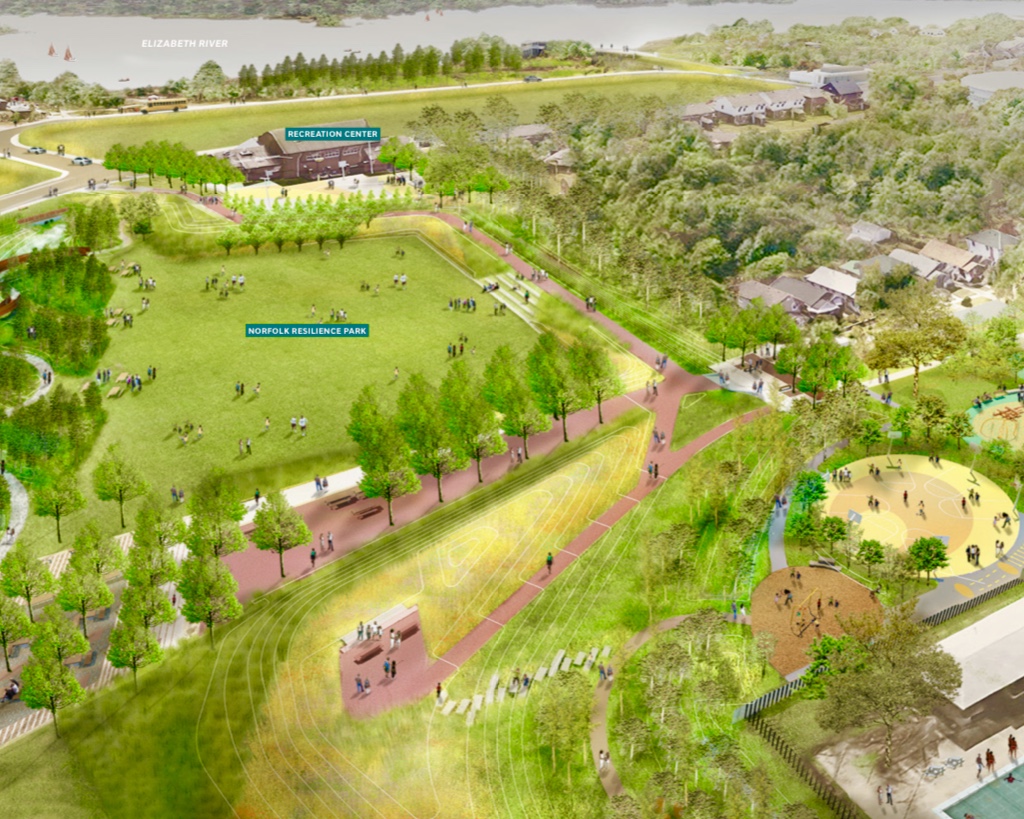
Virginia Gov. Ralph Northam, Norfolk Mayor Kenneth Alexander and community leaders recently broke ground on a project that takes the last approach to cope with sea level rise flooding. Resilience Park, part of the Ohio Creek Watershed Project, will create a green space to store and absorb floodwater. The project also includes a coastal flood berm, restored tidal creek wetland, and sports and recreational facilities.

A major plus to residents is that that project also includes a walking path that will connect two predominantly African American neighborhoods. “The Ohio Creek Watershed Project is an example of the kind of work we need to do to protect lives, property, and economic opportunity in Hampton roads, and the innovation that will help us build a safer, more sustainable, and resilient Virginia for future generations,” Gov. Northam said.

Virginia is using $112 million of a $120 million U.S. Department of Housing and Urban Development grant to fund the project.

Beachfront Real Estate Could Vanish in Some Areas Due to Sea Level Rise

Global warming and the sea level rise that’s coming with it could wash away over almost half of the world’s sandy beaches by 2100. That’s according to a study published this week on Nature Climate Change.

The loss of the beaches would have enormous economic implications. Beaches provide a barrier that protects real estate and whole cities from storm surge. They also create recreational opportunities that fuel tourism.

Scientists say stronger storms and manmade alterations, such as the construction of jetties and seawalls, are speeding up erosion. Add sea level rise to the mix and the situation becomes even more dire.

The outlook isn’t hopeless, however. The researchers say if humans cut down on greenhouse gas emissions, sea level rise could slow and shoreline retreat could be reduced by nearly 40 percent.

Buyers purchasing beachfront real estate need to consider beach erosion and how it could impact their property before they submit an offer.

The State of Septic Systems Has to be Considered when Purchasing Coastal Real Estate Under Pressure from Sea Level Rise

When purchasing real estate in coastal areas, buyers need to ask whether a property of interest is has a septic system and how well its operating. This question is especially important now that sea level rise is causing thousands of septic systems to operate less efficiently and even fail — sometimes well inland from the ocean.

Most septic systems take household waste water and pipes it into a holding tank buried in the yard. There, the solids sink to the bottom and the liquids flow into a leaching field where microbes in the soil treat and filter out the remaining impurities. Ideally, after that, the treated, purer water eventually flows into groundwater, nearby rivers and streams or the ocean without a problem.

Sea level rise disrupts the process by forcing the water table to rise. This saturates the soils that are needed to treat and filter out the impurities. As a result, the septic system outflow can pollute yards and contaminate groundwater and water on the surface.

When this happens, property owners usually have two choices: 1) Invest in improvements — such as raising the septic system if that’s feasible and adding more dirt to the system — or 2) Abandoning the septic system and tying into a city wastewater treatment system.

To protect themselves from unexpected expenses, real estate buyers in coastal areas need to know if a property is served by a septic system or already tied into the municipal sewer system. If the answer is septic, they need to have a home inspector determine if the system is operating well and how long it will be effective as seas continue to rise.

Sea Level Rise Poses Challenges for Commercial Real Estate

Residential real estate isn’t the only sector facing challenges from the threats posed by climate change and sea level rise flooding. Commercial real estate is under pressure, too.

According to a report recently released by Dechert LLP, a global law firm that advises corporations, financial institutions, sovereign states and wealthy individuals, “Climate change is forcing the commercial real estate industry to re-think the effectiveness of flood insurance that developers, lenders and investors have relied on for decades.”

The report notes that extreme weather and sea level rise flooding are pushing the commercial flood insurance system “to a breaking point.” Specifically, the report notes that 14 weather and climate disasters in the United States resulted in $91 billion in damages. Each event had losses exceeding $1 billion mostly from damage to residential and commercial real estate.

Among the challenges faced by the commercial real estate sector discussed in the report:

1) The National Flood Insurance Program (NFIP) administered by Federal Emergency Management Agency is financially unstable. The program is now running over $20 billion in the red, and it relies on government bailouts to continue to operate. Its authority to operate is due for renewal next fall. If it’s not renewed the report says, “The potential for disruption is most concerning for property owners in special flood hazard areas seeking mortgages from federally-backed entities and federally regulated banks because flood insurance is legally required for these loans.”

2) FEMA’s flood maps, which are supposed to identify a commercial property’s exposure to flood risk, are notoriously outdated and they do not consider sea level change or increased flooding estimates. “This has led to costly and catastrophic errors,” the report says. “For example, in 2018, at least 140 Florida homes were demolished following the destruction of Hurricane Michael. However, the relevant FEMA flood map reflected that the properties were in flood zone X (0.2% chance of flood in any year) and flood insurance was not required.”

3. Flood insurance only covers damages, not loss of value. The report says this is a problem because as properties become increasingly vulnerable to flooding, the will inevitably lose value over time. “The worst-case scenario here is particularly bleak,” the report says. “Billions of dollars of real estate will be underwater not only in terms of their market value being less than the outstanding mortgage debt, but also because these properties will be at greater risk of someday being literally underwater. Refinancing these mortgages and insuring these properties will undoubtedly become more challenging each passing year.”

The report goes on to explain how uncertainty in the flood insurance market is leaving the the commercial real estate finance industry without a “uniform strategy to underwrite the increased frequency and severity of flooding due to climate change.” The report says the public and private flood insurance industry “will soon be forced to adjust to face the environmental and economic realities of a country more prone to frequent, catastrophic and repeated flooding.”

The authors predict that the commercial real estate finance industry will evolve to meet the challenges to the marketplace. They identified several issues that need to be monitored: “Among the questions are whether the National Flood Insurance Program will be reformed, whether private flood insurers raise their rates to levels only wealthy real estate sponsors can afford, and whether banks and real estate bond buyers will call for more detailed disclosure to more accurately balance the risk of loss.”

The Dechert LLP report focuses on the commercial real estate industry, but most of its discussions, conclusions and warnings also apply to residential real estate. Buyers, sellers, owners and real estate agents in coastal areas should take the time to read this insightful report to better understand the broader issues that will impact their local real estate markets and property values.