Video: Real Estate Buyers Beware in Coastal Areas Experiencing Sea Level Rise Flooding

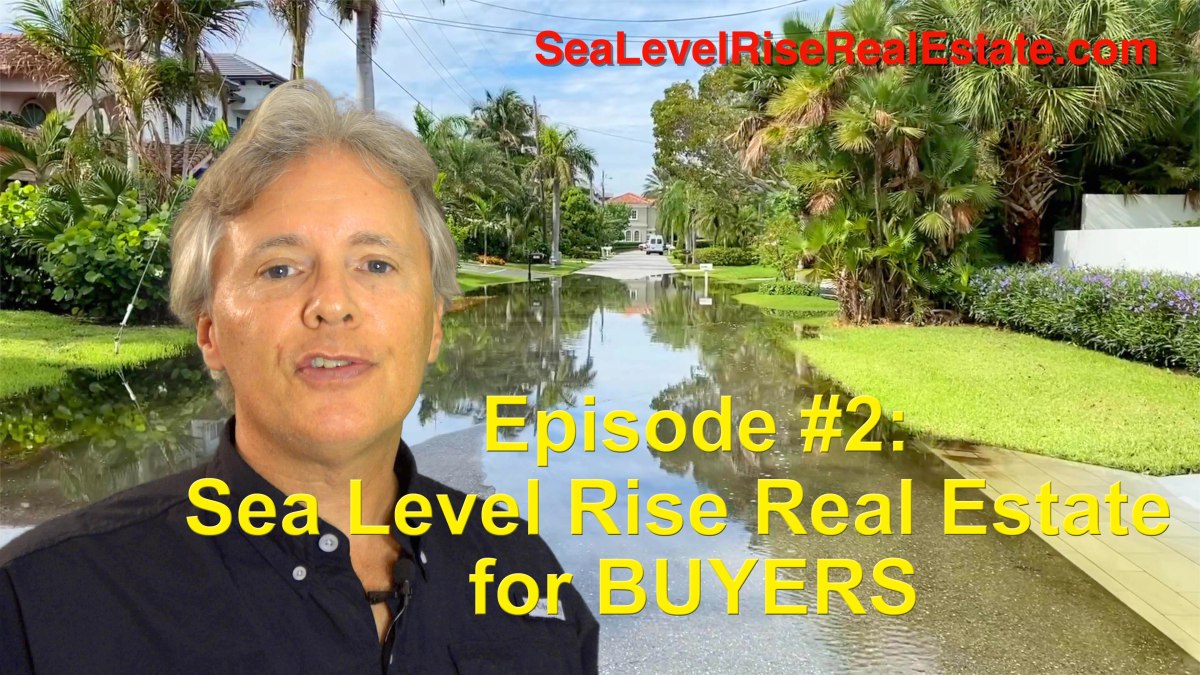
Buyers need to know the risks when they’re purchasing real estate in coastal areas that are experiencing sea level rise flooding. This YouTube video from Sea Level Rise Real Estate will give you an overview of the potential threats.

Many buyers in coastal areas are purchasing second homes or vacation properties. Too often they’re submitting offers without first finding out if the property or street out front is experiencing sea level rise flooding or if the property is in a neighborhood or community at risk of sea level rise flooding.

This failure to perform due diligence when buying real estate can prove costly. Properties that flood can have high maintenance costs and could actually lose value. In addition, owners of properties that flood or that are in the vicinity of flooding could face high taxes — as their communities struggle to deal with the flooding — flood insurance premiums and homeowners association or condo association fees.

In this video, I give buyers tips on how to find out if a property experiences sea level rise flooding, is at risk of flooding, or is in a neighborhood or community that floods. Then I discuss the risks the flooding can pose should they go through with the purchase.

Surprisingly, finding out if a property floods, itself, can be a real challenge. For instance, often the flooding only occurs during the fall king tide season or when a storm is whipping up the water so buyers won’t see it. Furthermore, in some states sellers don’t have to disclose the flooding problem to buyers.

“Sea Level Rise Real Estate for BUYERS” is the second in a five-part series I produced for SeaLevelRiseRealEstate.com based on my book “7 Sea Level Rise Real Estate Questions for Buyers, Sellers, Owners & Real Estate Agents.” The book goes into far greater detail.

Florida Bill Would Establish State-level Coordination of Sea Level Rise Response

Florida legislators are considering a bill that would establish a state-wide Office of Resiliency and a task force to research the best ways to protect the Sunshine State’s 1350 miles of coastline from sea level rise flooding.

The legislation, which has bipartisan support, is needed to help communities coordinate their response to sea level rise. With years of state-level climate change neglect, governments in South Florida and the Keys have formed their own regional compact to study the problem and seek ways to meet the challenge that complement each others’ efforts. State leadership and funding would certainly help them.

According to a Finance & Commerce report, the proposal could still face some political headwinds in Tallahassee. Environmentalists would like to see the new resiliency office deal with both sea level rise and the causes of climate change.

Sea Level Rise Flooding Could Force 13 Million People to Move Inland by 2100

Resiliency and retreat are the mantras for coastal communities coping with sea level rise flooding. Resiliency is improving infrastructure to allow people to remain in coastal areas. Among the options are raising sea walls, roads and other critical infrastructure and installing pumps to move floodwaters off valuable real estate. Retreat is moving people away from areas that flood when it’s too expensive or impossible to defend the land.

Researchers at the University of Southern California’s School of Engineering used artificial intelligence to predict where coastal residents are likely to migrate when sea level rise forces them inland. Their report might surprise you.

The study, led by USC Computer Science Assistant Professor Bustra Dilkina found that sea level rise flooding could force 13 million people in the US alone to move inland by 2100. The inland cities that take them will face increased competition for jobs, higher housing prices and greater demands on essential public services, including roads, schools, law enforcement and water and sewer services.

“Sea level rise will affect every county in the US, including inland areas,” Professor Dilkina fold USC Viterbi. “We hope this research will empower urban planners and local decision-makers to prepare to accept populations displaced by sea level rise. Our findings indicate that everybody should care about sea level rise, whether they live on the coast or not. This is a global impact issue.”

The study identified which cities and regions are likely to fact the largest influx of sea level rise refugees. The list includes Atlanta, Houston, Dallas, Denver and Las Vegas. Smaller midwest cities could also face a spike in population from people moving away from the coasts.

Miami’s Sea Level Rise Real Estate Challenges Coming Soon to a Coastal Community Near You

Miami’s extremely low elevation puts the city at the front lines of the battle against sea level rise flooding. The city is constantly grappling with ways to control floodwaters that are serving as a general guide for other cities and town all along the Atlantic, Pacific and Gulf of Mexico coastlines.

This week, the city of Miami unveiled its “Miami Forever Climate Ready” plan to combat climate change and sea level rise flooding. Jane Gilbert, the city’s resiliency chief, said the plan outlines 86 actions that need to be taken to control flooding and reducing the city’s carbon footprint.

Among the recommendations to address climate change heat are making buildings more energy-efficient, buying electric vehicles, and planting more trees. To meet the challenge of rising seas, the city plans to upgrade failing stormwater system, raising sea walls, installing stormwater pump stations, and creating wetlands to shift floodwaters from city streets. In areas that experience extreme flooding, the city is considering buying out private property, which, in many cases, is cheaper than rebuilding structures that are repeatedly damaged by floodwaters.

Massive amounts of money will be needed for the city to address sea level rise flooding and climate change, which will worsen in the decades to come. City officials say the challenge is finding funding for the projects when real estate could lose value, which would reduce the amount of tax revenue the city has to work with. If this happens, issuing bonds to pay for the projects could also become more difficult.

Despite the challenges, the report says Miami shouldn’t wait to implement the recommendations. The report says, “Now is the time, while Miami’s economy is still growing, to turn this climate change into an opportunity.” In 2017, Miami voters approved a $400 million bond to improve the city’s sea level rise flooding defenses.

Buyers, sellers, owners, and real estate agents need to know what their local governments are doing to combat sea level rise for several reasons: 1) The projects could impact their tax rates and flood insurance premiums; 2) The projects could determine whether or not their property floods; 3) The project’s effectiveness could impact their property value; and 4) The projects could impact their quality of life if nearby seawalls are raised or pump stations are installed.

Who Murdered Climate Change and Sea Level Rise Denialism? Find Out in This Whodunnit Video!

For decades, many climate change and sea level rise denialists have aggressively fought against the 97 percent of climate scientists who agree that climate change and sea level rise are for real and they’re growing worse every year.

The denialist also turned a blind eye to the natural disasters — the intense wildfires, floods, droughts, tropical weather systems — that are plaguing the planet. There was, however, a recent development that should finally drive a wooden stake through the hearts of those who refuse to believe the climate scientists or the slow-motion but escalating disaster we’re all witnessing with our own eyes. Watch this murder mystery video to find out whodunnit.

I’ve also posted several videos that explain what Sea Level Rise Real Estate is and how it can help buyers, sellers, owners, and real estate agents to protect their financial futures from rising seas. Enjoy!

Now You Can Binge Watch the FREE Sea Level Rise Real Estate Introductory Video Series!

Sea level rise flooding is a growing problem for coastal communities along the Atlantic, Pacific and Gulf of Mexico coastlines. Unfortunately, there isn’t a lot of information out there — and certainly not in one place — to help buyers, sellers, owners, and real estate agents to make informed decisions about how to respond to the challenge.

I created SeaLevelRiseRealEstate.com and wrote “7 Sea Level Rise Real Estate Questions” to give people an understanding of climate change and sea level rise, along with the questions they need to ask and the valuable resources that can provide useful answers, so they’ll make the right decisions based on the threats posed by sea level rise flooding and their ability to address them. To further reinforce the points made on the website and in the book, I produced five introductory videos that I’m posting on this site all at once.

The videos consist of an introductory video followed by videos that each address the central issues that should be of concern to buyers, sellers, owners, and real estate agents. The videos aren’t as comprehensive as the information found in “7 Sea Level Rise Real Estate Questions” but they give a great overview of the general issues of concern.

You can view the videos by clicking this link.

Australian Executives Recognize Climate Change Threat

After months of witnessing their country battling fierce wildfires, a majority of Australian business executives who participated in a Deloitte survey worry that climate change poses a threat to their companies. Eighty-one percent of the business leaders told Deloitte that they were concerned climate change could harm their businesses.

The Australian executives’ level of concern is much higher than the global average. Forty-eight percent of business leaders in 18 other countries surveyed said they were worried about climate change.

Robert Hillard, a Deloitte Australia executive, said, “Businesses need to demonstrate to investors that they are taking appropriate steps to mitigate their exposure.”

Top Australian government officials, including Prime Minister Scott Morrison, have sparked public anger by denying climate change is a problem. Morrison says the Australian economy will be damaged if it seeks to further reduce carbon emissions. Coal, a major greenhouse gas contributor, is the country’s number two export.

The business world was rocked last week when Larry Fink, the founder of BlackRock, Inc., the world’s largest investment management corporation with nearly $7 trillion in assets under management, sent a letter to chief executives that said his firm would consider a company’s climate change record when deciding where to invest. Fink said companies needed to consider the impact of climate change and sea level rise and act accordingly to protect their bottom lines.

Buyers, sellers, owners, and real estate agents — who are essentially acting as chief executives managing their own financial futures — need to follow the business leaders’ example and consider climate change and sea level rise when they’re deciding how to proceed in a real estate transaction.

Virginia Beach Needs Billions of Dollars to Fight Sea Level Rise Flooding

An engineering firm that spent five years studying Virginia Beach’s flooding problem recently presented a report to the city council that says the city will have to spend up to $3.8 billion to manage sea level rise flooding.

To draft its recommendations, Dewberry estimated that seas will rise about 1 1/2 feet between 2035 and 2055 and 3 feet between 2065 and 2085. Sections of the city already experience coastal flooding. More areas will be inundated as the seas rise.

Among the firm’s recommendations are the construction of high-tech flood gates along with more seawalls and levees. The engineers also said the city should consider buying out about 2,500 homes that are at risk of flooding and restricting development in vulnerable areas.

The city council and planning commission are going to consider all aspects of the report before approving its conclusions. Officials say they also need to consider funding sources. They say residents can’t afford to pay all of the billions of dollars needed to protect the city. They’ll have to seek federal assistance.

Communities all along the Atlantic, Pacific and Gulf of Mexico coastlines grappling with sea level rise flooding and the need to protect valuable real estate and other assets are struggling with how to pay for hundreds of millions and even billions of dollars worth of needed construction projects. Buyers, sellers, owners and real estate agents need to consider the plans when they’re deciding how to respond to the challenge.

Report Predicts 15%-35% Drop in Florida Home Values Due to Climate Change and Sea Level Rise

A report released by McKinsey & Company, a global management consulting firm, predicts that Florida homes exposed to sea level rise flooding and storm surge from stronger hurricanes — fueled by a warmer atmosphere and ocean water — could lose 15-to-35% of their value by 2050. That translates into $30 billion to $80 billion worth of devaluation.

The company, which studied past trends to arrive at the estimate, says if not effectively addressed, flooding could result in lenders no longer offering 30-year mortgages in affected areas. Furthermore real estate owners could get hit with higher insurance premiums and possibly lose access to insurance altogether if providers leave the market.

If the coastal real estate market faces a downturn due to sea level rise flooding, the report says there’s also a concern that property tax revenues will be reduced, leaving communities with less funding to address the problem.

The report’s authors warn that their estimates may be on the conservative side. Losses could be much higher if water, sewage and transportation systems are flooded or buyers become much more sensitive to climate risk when purchasing properties.

The researchers say Florida is going to have to make hard choices to address sea level rise flooding. The state will have to decide whether to protect the coasts with seawalls and other methods or abandon risk-prone areas.

To protect their financial futures, real estate owners everywhere need to pay close attention to how federal, state and local governments plan to protect their communities from the threat of sea level rise flooding.

New York City Debates Whether a $119 Billion Barrier is Enough to Hold Back Sea Level Rise

New York City and the Army Corps of Engineers are considering five options to protect the city from sea level rise. Among them is a six mile long set of retractable gates that would stretch from Queens, NY, to New Jersey.

Supporters see many benefits from the gates. They say the barriers would be far enough off shore to be out of sight for most land dwellers, they’d hold back storm surges, similar to the one from Hurricane Sandy that swamped lower Manhattan, and they’d be better at protecting everyone, not just the wealthy areas that are being shielded from flooding by land-bound solutions currently being built.

Opponents, however, worry that by the time the gate project is completed in 25 years it will be obsolete because of sea level rise. They’re also concerned that it will create even more problems for the city by preventing stormwater runoff from escaping back into the sea.

Residents, government officials, the Corps of Engineers and environmental groups will make the final decision. In the meantime, real estate owners along the city’s 520-mile coastline and adjacent areas need to keep informed about the debate and get involved if their property will be impacted.

You can read more about the great New York sea level rise debate in this New York Times article.