
The Destructive Relationship Between Sea Level Rise and New Coastal Real Estate Development

Living in a coastal community that’s experiencing sea level rise flooding, I’m amazed at the hundreds of millions of dollars of new commercial and residential real estate being built in neighborhoods that are flooding today or that will soon be subject to floodwaters as the seas continue to rise.

When I ask my real estate agent friends what they think about the situation, they are always quick to remind me that Florida’s economy is heavily reliant on new building projects and the jobs, investment and tax dollars they bring for its very survival.

Many cities and towns along he Atlantic, Pacific and Gulf of Mexico coastlines are equally addicted to new development to keep their economies rolling and their governments solvent. There is, however, clearly a downside to this relationship.

As sea levels continue to rise, those same coastal cities and towns are going to have to start to invest heavily in flood mitigation strategies, such as raising roads and water and sewer pipes, building or raising sea walls and installing pumps. In some cases, they may even have to buy-out homes and whole neighborhoods that flood repeatedly. When this day arrives — and it has already arrived in parts of the Florida Keys and other vulnerable locations — what seemed like a good idea today — allowing hundreds of millions of dollars in new development in areas vulnerable to sea level rise — will have enormous costs to taxpayers and property owners.

Taxpayers will have to pay the tab to protect the expensive new flood mitigation projects. And the higher taxes to pay for those projects, combined with the higher insurance premiums that go hand-in-hand with sea level rise flooding, could cause property values to plummet.

Linda Shi, an assistant professor in Cornell University’s department of city and regional planning, wrote an op-ed titled “The fiscal challenges of climate change” for the Boston Globe. In it, she explains the challenge posed by new coastal development in the age of rising seas. She studied the Massachusetts coastline in detail and discovered:”Statewide, 40 percent of local revenues come from property taxes; along the coast, 60 percent; and in some coastal suburbs, 70-80 percent. State expectations that local governments self-finance most of the services they provide inevitably incentivize continued development wherever possible, placing coastal sites and cities on a collision path with rising seas.”

Shi says the negative cycles could be reversed if cities and states included fiscal considerations into sea level rise flooding vulnerability assessments. She also said regional land-use planning agencies and non-governmental organizations could help by evaluating “how climate change affects local budgets, how fiscal vulnerability and adaptation choices impact the region and vice versa.” Their input would help communities to decide where to allow new real estate developments to minimize the eventual costs that arise due to sea level rise flooding.

The future costs of placing new developments in or near sea level rise flood zones is an important issue to consider today. Making informed decisions will protect subsequent generations from the high cost of protecting or decommissioning billions of dollars worth of real estate our generation knew was at-risk before ground-breaking shovels were turned.
Norfolk Neighborhood Breaks Ground on Sea Level Rise Diversion Project

When confronted by sea level rise flooding, neighborhoods have a choice: Try to hold the waters back, move out of the area, or divert the water into areas designed to accommodate floodwaters.

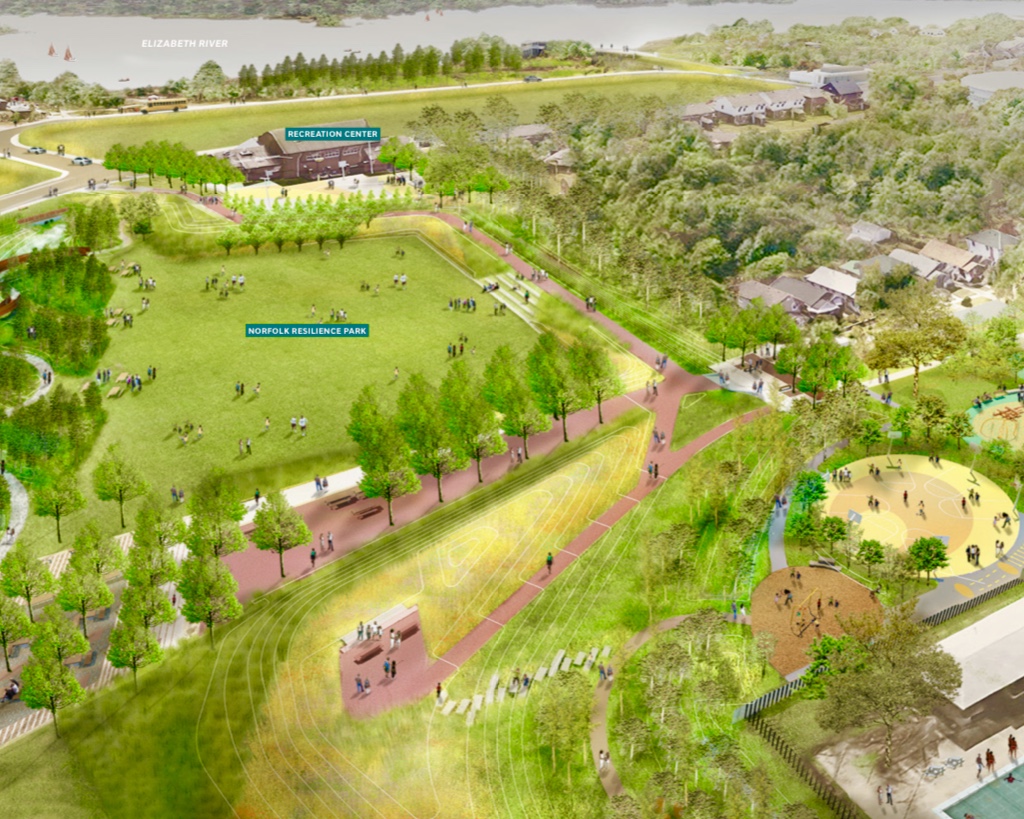
Virginia Gov. Ralph Northam, Norfolk Mayor Kenneth Alexander and community leaders recently broke ground on a project that takes the last approach to cope with sea level rise flooding. Resilience Park, part of the Ohio Creek Watershed Project, will create a green space to store and absorb floodwater. The project also includes a coastal flood berm, restored tidal creek wetland, and sports and recreational facilities.

A major plus to residents is that that project also includes a walking path that will connect two predominantly African American neighborhoods. “The Ohio Creek Watershed Project is an example of the kind of work we need to do to protect lives, property, and economic opportunity in Hampton roads, and the innovation that will help us build a safer, more sustainable, and resilient Virginia for future generations,” Gov. Northam said.

Virginia is using $112 million of a $120 million U.S. Department of Housing and Urban Development grant to fund the project.

Beachfront Real Estate Could Vanish in Some Areas Due to Sea Level Rise

Global warming and the sea level rise that’s coming with it could wash away over almost half of the world’s sandy beaches by 2100. That’s according to a study published this week on Nature Climate Change.

The loss of the beaches would have enormous economic implications. Beaches provide a barrier that protects real estate and whole cities from storm surge. They also create recreational opportunities that fuel tourism.

Scientists say stronger storms and manmade alterations, such as the construction of jetties and seawalls, are speeding up erosion. Add sea level rise to the mix and the situation becomes even more dire.

The outlook isn’t hopeless, however. The researchers say if humans cut down on greenhouse gas emissions, sea level rise could slow and shoreline retreat could be reduced by nearly 40 percent.

Buyers purchasing beachfront real estate need to consider beach erosion and how it could impact their property before they submit an offer.

The State of Septic Systems Has to be Considered when Purchasing Coastal Real Estate Under Pressure from Sea Level Rise

When purchasing real estate in coastal areas, buyers need to ask whether a property of interest is has a septic system and how well its operating. This question is especially important now that sea level rise is causing thousands of septic systems to operate less efficiently and even fail — sometimes well inland from the ocean.

Most septic systems take household waste water and pipes it into a holding tank buried in the yard. There, the solids sink to the bottom and the liquids flow into a leaching field where microbes in the soil treat and filter out the remaining impurities. Ideally, after that, the treated, purer water eventually flows into groundwater, nearby rivers and streams or the ocean without a problem.

Sea level rise disrupts the process by forcing the water table to rise. This saturates the soils that are needed to treat and filter out the impurities. As a result, the septic system outflow can pollute yards and contaminate groundwater and water on the surface.

When this happens, property owners usually have two choices: 1) Invest in improvements — such as raising the septic system if that’s feasible and adding more dirt to the system — or 2) Abandoning the septic system and tying into a city wastewater treatment system.

To protect themselves from unexpected expenses, real estate buyers in coastal areas need to know if a property is served by a septic system or already tied into the municipal sewer system. If the answer is septic, they need to have a home inspector determine if the system is operating well and how long it will be effective as seas continue to rise.